Construction Worker Hearing Protection

National Protect Your Hearing Month is observed annually in October. You may not think hearing loss is a big problem, but it’s not just people who work with heavy machinery who are at risk of permanently damaging one of their five senses. Hearing loss is a 24/7 problem that happens both at work and at home—or wherever else you may be when you’re off the clock.

According to the National Institute for Occupational Health & Safety (NIOSH), hearing loss is actually the third most common chronic physical health condition among adults, after high blood pressure and arthritis.

Some people may not want to admit they have trouble hearing, and that denial means hearing loss often goes untreated. In fact, Dr. Frank R. Lin, who heads the Cochlear Center for Hearing and Public Health at the Johns Hopkins Bloomberg School of Public Health, determined that 85 percent of people with hearing loss are left untreated. But poor hearing is not just a minor inconvenience. The longer people wait to get their hearing testing and start treatment, the harder the hearing loss is to treat.

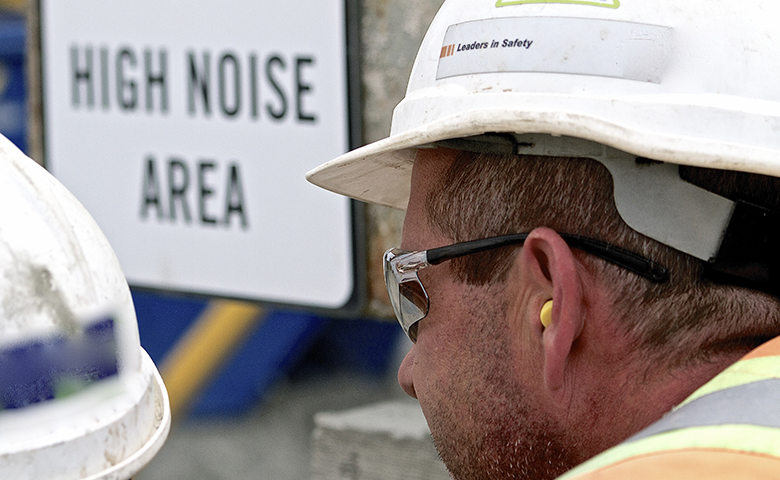
A lack of understanding and belief in the myths surrounding hearing loss is a big part of the problem. One myth is that hearing loss is always temporary and that only very loud noises are harmful. In reality, the risk from noise exposure is dependent on several factors, such as the sound’s intensity (decibel level), length of exposure and how often you’re exposed. Extended exposure to noise levels above 85 decibels can cause permanent hearing loss. If you’re like most people, encountering sustained 85 decibel sounds is common—it’s the equivalent of a noisy restaurant or hotel lobby, inside an airport or a roadway with heavy traffic. But even then, the maximum time one can safely endure 85 decibels is 8 hours. If you live or work near any of these loud places, you may want to consider hearing protection. 

Another common myth surrounding hearing loss is that your ears will “get used to” loud noises. Your ears don’t react the same way your nose does when exposed to smells, becoming nose blind (when odors are no longer noticeable after prolonged exposure). 

Here are a couple of other myths that people believe, increasing the risk of hearing loss:

Myth: I’m not old or around loud noises often, so I am not at risk of hearing loss.

Fact: Age and noise exposure are definitely the most common causes of hearing loss, but several other contributing factors might surprise you. Ear infections can damage the inner ear, especially if left untreated. And while most people aren’t shocked to hear about ear infection-related hearing loss, what about smoking and vaping? Studies show that smoking and vaping both have negative effects on hearing. The smoke can irritate your middle ear lining, which makes you more susceptible to noise-induced hearing impairment.

Stress and anxiety are other causes of temporary and permanent hearing loss. Stress releases a hormone called cortisol, which causes inflammation throughout your body, including in your middle ear. Stress can also weaken the immune system and lead to temporary hearing impairment. Over time, chronic stress can lead to more serious medical conditions, resulting in permanent auditory damage. Hypertension, diabetes, and heart disease can cause damage to the tiny blood vessels in the inner ear, and obesity can also exacerbate conditions that bring on hearing loss.

Myth: Hearing loss doesn’t affect the rest of my health.

Fact: Hearing loss can significantly impact your state of mind. Struggling to hear can be exhausting, literally. The cognitive strain of trying to process hearing loss causes mental fatigue. The fatigue that comes from straining to hear will trickle down into the rest of your life, making you more vulnerable to the risk of injury. It can also contribute to the development of new health conditions.

Untreated hearing loss can also result in stress and frustration. And if you don’t adjust for that stress and frustration, it could lead to injury-causing errors. SafeStart’s Stress and Safety handout states: “When people are stressed, they pay less attention. And when people don’t pay attention to what they’re doing, they’re more likely to get injured. Stress makes people rush more and get more easily frustrated. It also makes people more susceptible to fatigue and more likely to become complacent. In short, stress gets people hurt and killed.” Stress management is important to maintain a healthy existence, so it’s important to protect your hearing.

The first step to protecting your ears is early recognition of hearing loss. According to NIOSH, signs of hearing loss include:

  •       Having difficulty hearing when there is background noise.
  •       Thinking people are mumbling when they talk to you.
  •       Asking others to repeat themselves often.

If you’ve brushed off these signs as nothing, maybe it’s time to talk to your doctor about hearing loss.

Share this information with your facility this October—either as a toolbox talk, as a printed handout or in a digital display presentation—to provide people with more information about hearing loss. Recognizing these issues as common and addressing the problem can prevent hearing loss from worsening.  

On-demand webinar

Dead Tired: What Every Company Must Know About Fatigue

Fatigue is one of the most significant issues that companies face in every industry, as it affects safety, quality and productivity. Workers aren’t just tired—they’re dangerously impaired. This presentation will help you develop a plan to manage fatigue both corporately and individually.

Watch now

Tagged , , , , , , , , ,

Emergency call 911. Unconscious person lying on the floor. SOS ambulance alarm with phone in hand. Urgent medical help aid.

Drug overdoses are a deadly reality for many communities across North America. They are also shockingly prevalent in the workplace.

Two years ago (which is the last year for which we have a full set of data), unintentional overdoses from drugs or alcohol accounted for 9.7% of all workplace fatalities—nearly one-in-ten people who died on the job did so because of an overdose. And while Injury Facts shows that there is an overall decrease in workplace fatality rates, the number of unintentional overdose deaths on the job has increased every single year for the past decade, with over 500 workplace overdose fatalities in the last year on record. 

Safety issues like driving, lockout/tagout and falls from heights garner a lot of attention in the pages of safety magazines, and with good reason—they are major causes of serious injuries and fatalities. But they tend to overshadow overdoses, which are one of the fastest-growing types of fatal incidents. Since 2011, the number of deadly overdoses has increased by over 600%. As Injury Facts notes, “Increases have been experienced among all employee demographics, industries, and occupations.”

Of course, overdose deaths aren’t strictly confined to the workplace, with over 105,000 people in the United States dying from drug-involved overdoses in the last year on record. Overdoses from opioids and other substances are a complicated issue, with a number of individual and social factors influencing the likelihood of drug and alcohol use.

Any way you look at it, overdoses are a capital-P Problem. They’re a problem at work, they’re a problem at home, and there is no single solution that will make the issue go away. But given how many people die on the job because of overdoses, it’s a challenge that has obvious implications for safety managers. There is also an undeniable connection between workplace safety outcomes and overdose deaths, both at work and in the community.

In the past five years, there have been two studies that found that workplace injuries are a major driver of overdose deaths. While both studies were conducted independently of each other, they reached substantially similar conclusions about the close ties between safety outcomes on the job and the risk of overdose deaths in the months and years following an injury.

The first study reviewed three years of insurance claims. It found that the hazard of opioid morbidity was 2.91 times higher for workers who suffered a lost-time injury than for workers who were uninjured. To put it another way, injuries that force someone to miss time at work nearly triple the worker’s risk of a fatal opioid overdose. The study concluded that “Reducing workplace injury or severity of workplace injury, as well as efforts to ensure appropriate opioid prescribing for injured workers, may help to reduce the societal costs of opioid use.”

The second study discovered that the majority of prescription pain relievers, such as opioids, were used to alleviate chronic pain, and that this pain often originated from the workplace. As the study authors offer in an aside, “Attending to conditions of work may have significant potential for effective public health action to combat the opioid crisis.” The study goes on to point out that “57% of opioid-related overdose deaths occurred after a work injury, with 13% of overdose deaths preceded by a work injury within the past 3 years of death.” All told, it’s clear that workplace injuries can be a significant factor in the number of overdose deaths that occur at work and beyond.

The rising number of fatal overdoses is a clarion call for more active safety leadership on the issue. Educating workers on overdose deaths and providing naloxone kits are two steps that safety professionals and organizational leaders can take to cut down on the risk of deadly overdoses in the workplace. Based on the findings of the studies cited above, taking additional steps to reduce injuries can also go a long way to prevent not only an initial incident but also a secondary overdose tragedy.

For workplaces that have covered all the standard compliance measures and have established a safety management system, it may seem like the employer has all the bases covered and there is no obvious route to further injury reduction. That’s where human factors management comes in.

Mental and physical states like rushing, frustration and fatigue are an influence in a disproportionate number of workplace incidents. So it stands to reason that getting better at managing human factors in the workplace—from teaching workers more personal safety skills to improving supervisors’ ability to recognize human factors in their team—will lead to fewer injuries and fewer resultant overdose incidents.

It’s overly simplistic to think that human factors management is a silver bullet for overdose deaths. There are simply too many contributing factors to the issue for that to be the case. However, using human factors to reduce injuries is another weapon in the arsenal to help fight back against opioids and other substances. It’s also a great way to reduce injuries and improve employees’ situational awareness.

At the very least, it’s worth recognizing the strong links between injuries and overdoses. A clearer picture of one of the primary causes of drug and alcohol use can make it easier to take both small and large steps to mitigate the risk of fatal overdoses in the workplace.

On-demand webinar

Using a Human Factors Framework for Safety and Operational Excellence

It can be hard to see the connection between safety, productivity, human factors and organizational systems. This webinar will demonstrate how a human factors framework can impact all areas of an organization, linking individual worker safety and organizational systems and provide an outline that allows leadership to manage safety-focused change.

Watch now

Tagged , , , , , ,

Man delivering funny presentation

Employees often complain that safety training is boring and unengaging. Humorous safety presentations have been known to create more interactivity, make training concepts more memorable, increase engagement with safety ideas and have higher knowledge retention among employees. 

It’s one thing to want to add humor to your safety training presentations, but it’s another, actually, to find the humorous material to do so. Here are some tips and tricks on where to find humorous material worthy of adding to your safety training presentations.

People watching. 

Not in a creepy way, but have you ever just sat and watched people in everyday interactions? People watching is a great pastime that will reveal the idiosyncrasies in everyday life. Prime locations are airports, Walmart (the people of Walmart are so fun to watch that they have their own website), the mall, bars or any public transportation. 

These are also great places to observe human error—from shopping cart blunders at the grocery store to people texting and walking into someone/something. You can translate these common behaviors to your work environment to highlight serious potential outcomes. Set it up like a comedian would: “Have you ever noticed people at the mall…” or “The other day when I was grocery shopping, I saw…” 

Go to a comedy club.

This one might seem obvious, but it’s worthwhile to check out a comedy club when preparing for your presentation. Comedians are big proponents of telling stories from their own lives and making observations. Don’t rip off their act word for word, but take note of how they deliver a story or listen to the observations they make and see if it inspires you for your own presentation. 

Another thing that comedians do well is make people feel like they’re in on the joke. They don’t make fun of them. Rather, they position their bits like: “Do you ever feel like…” or “Have you ever noticed…” speaking directly to the audience. Even though the question is rhetorical, the audience ponders their response, they feel included and the outcome is typically a laugh since everyone is in on the joke.

Once you train your brain to look for comedy, you’ll see that it’s everywhere.

Safety conference sessions and workshops. 

You might be surprised to find that people are already doing humor in safety—and they’re doing it well. The humor is usually subtle, so that may be why you haven’t heard about the hilarity in these safety sessions, but it’s enough to make the presentations enjoyable and ensure the audience retains the information. Check out some conferences and workshops around the safety industry and see how they’re presented—you never know what you’ll be able to borrow for your own benefit. 

Shameless plug: There’s a reason SafeStart speakers are continually on the “Top 10” speakers lists; they are often asked to come back to present at the same conferences due to their popularity, and their sessions are standing room only. If you want to see how humor in safety is really done, check out any SafeStart consultants’ sessions. 

Videos. 

YouTube is a video-sharing website that hosts a wide range of clips, videos, trends and channels uploaded by individual users. This is a good place to find relatable material for the content you’re delivering. You can subscribe to channels that you find useful for the ease of sharing their content in the future. If you need a video clip to support your topic, YouTube probably has something for you.

Don’t forget: A lot of times, the stuff you find on the internet is protected by copyright. If you’re not sure, ask for permission to use it and cite the source.

Television, movies and print. 

When you can relate to the audience through something they’re interested in, you instantly develop a connection with them. Since pop culture is a way to connect with your audience, movie references or clips will help you do just that. 

Situational comedy easily lends itself to training sessions. So take a page from sitcoms (yes, that stands for situational comedies) like Modern Family, The Big Bang Theory or Brooklyn Nine-Nine, or go back to some older ones like Seinfeld, How I Met Your Mother or Friends. Remember to gauge your audience; if they aren’t in the right demographic to have watched the television show, you won’t be able to relate to them.

Relevant books, magazines, newspapers or other related print can also speak to your audience on a level they didn’t expect. “I read this article the other day…” Once that bond is established, you have their trust and they will look forward to the material you deliver.

You can often find clips from sitcoms on YouTube if you need a little help demonstrating your point.

Social media. 

No matter what your social media preference is, there are a lot of outlets for funny material. X (formerly Twitter) can be a great source for hilarious content. Have you ever seen celebrities read mean tweets? In theory, it shouldn’t be as funny as it is. To look for helpful material, you can follow funny people on social media or peruse the numerous websites and feeds dedicated to humor. Some of them even focus on safety, so it’s not that hard to find something that speaks to a wide range of humor tastes.

The whole point of humor in safety presentations is to introduce a little fun. While it may not specifically be humorous, adding a fun element to your presentation will have the same effect. Games are a great way to inspire retention and also add a positive, fun element to the training. Look for free game show templates online or other free training games. Or make your own game like “Caption This,” putting related safety activities, concepts, or catch phrases to pictures, is a fun way to get the audience to retain the information you’re delivering. 

To give yourself a jumpstart on infusing presentations with fun, you can check out some free training games online or, if you’re in the mood to play the role of TV host, use a gameshow template.

Don’t be afraid to step outside of what you’ve been told a traditional presentation should look like. Unexpected elements are what engage the audience and help them retain the information you’re trying to convey. Give folks a laugh when you’re delivering your next presentation and they’ll reward you with their attention. 

This blog post is an excerpt that was adapted from Seriously Funny: How to Use Humor in Safety, which reviews the what, where, why and how to do humor in safety presentations in an easy-to-digest guide. Download it for tips, tricks and useful advice to add humor to workplace safety presentations.


Free guide

Seriously Funny: How to Use Humor in Safety

Take your standard safety presentation to the next level by introducing humor. Research has shown that humor can improve how you are perceived as a trainer—in addition to increasing participation, retention and overall enjoyment of the material.

Get the free guide now

Tagged , , , , , ,

Workers on a construction site trying to figure something out

Complacency can happen to anyone, anywhere. It’s not just something that happens at work, it can also occur at home or while driving. When a person becomes comfortable with what they’re doing and no longer thinks about any associated hazards, that’s complacency. It’s dangerous and difficult to recognize, but there is a natural reason our minds and bodies go on autopilot.

The word complacency is congruous with its definition in that it doesn’t strike fear in anyone. When people are in a state of complacency, they aren’t thinking about the risks waiting to harm them around the corner. The word isn’t threatening in the same way people don’t feel threatened when they’re in that state of mind.

Because of that, complacency is one of the most underrated causes of human impairment. Even though it is widely recognized as a problem, complacency is often underacknowledged as a contributing factor when more prominent causes like fatigue or rule-breaking are available to cite more easily. But when companies fail to mitigate complacency’s potential effects, does that mean that complacency is a choice?

Complacency is a natural human function, mostly subconscious and usually only identified in oneself retrospectively. With that information alone, it would be easy to say that no, complacency is not a choice.

But if you’re reading this, there’s a good chance that you’ve identified complacency as a problem, so you must realize there is some level of choice, especially when seeking to prevent workplace incidents and injuries.

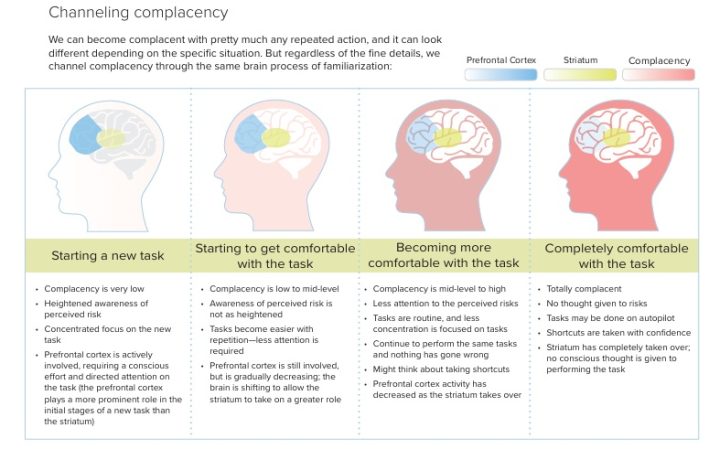
One journal paper shows that complacency is a neurological function of the brain. The prefrontal cortex (the front part of the brain responsible for seeing and predicting the consequences of behavior, decision-making, reasoning, problem-solving, and regulating emotions) and the striatum (which is interconnected with the prefrontal cortex and functions as the intermediary between emotions and actions) work together, and every time you do something new, they fire on all cylinders to process the new task. However, as the task is repeated, the action gets easier and fewer neurons fire. The brain no longer requires the prefrontal cortex and the striatum to take over to complete the task as a habit.

We can become complacent with pretty much any repeated action, and it can look different depending on the specific situation. But regardless of the fine details, we channel complacency through the same brain process of familiarization:

Channeling complacency

Channeling Complacency

This example will walk you through the channeling complacency model. Since complacency can happen in any industry, it’s helpful to look at a detailed real-world example that most of us have gone through—driving—to help recognize the pattern in action.

Starting a new task — Learning to drive a car/forklift

Think about when you first started learning how to drive a car. Driving is one of the riskiest things we do, yet most drivers become so comfortable with the task that they no longer think about the risks involved. New drivers, however, are very aware of the risks and are most likely to do everything by the book in order to stay safe. Tasks in this stage are performed at full attention, and complacency is very low. This checklist resembles all of the things that drivers should do when they are about to set out on the road to stay safe (it is not a comprehensive list and should only be referenced for this example). At this stage, the prefrontal cortex and the striatum have the checklist at the ready and adhere to it more strictly to prevent the risks from turning into costly errors or injuries.

□       Do a circle check around the vehicle to identify any safety issues on or around the vehicle               before starting a drive.

□       Inside the car, adjust the mirrors and seat and ensure all controls are set before putting the             car into gear.

□       Putting on your seatbelt is another important step that happens before moving the vehicle.

□       Keep the radio off or the volume low to ensure it doesn’t interrupt concentration.

□       Place both hands on the steering wheel in the clock positions of 9 and 3.

□       Be cognizant of all of the rules of the road, scan for and identify all hazards.

□       Check mirrors often to be alert of your surroundings.

□       Brake and accelerate smoothly (count to three to ensure a full stop at a stop sign).

□       Maintain appropriate speed and keep a safe following distance.

□       Slow down before turns and signal intentions early.

□       Check blind spots with a shoulder check after signaling intentions before changing lanes.

□       Scan the road continually, especially approaching intersections.

This list can go on and on, but it’s a good example of how a new driver puts their entire focus on the new task checklist in the first stage of the channeling complacency model, having a heightened awareness of safety and a hyper-concentration on all of the risks surrounding the act of driving.

The same rules apply to learning to drive a forklift in the workplace.

□       Do a visual circle check before starting the forklift.

□       Do an operational check to make sure the forklift and controls function appropriately
         (similar to what is performed inside a car).

□       Putting on your seatbelt is a must in forklifts, too.

□       Use both hands to maintain control of the steering wheel.

□       Be cognizant of all of the rules of the floor, scan for and identify all hazards.

□       Adjust and check mirrors (if your forklift model includes mirrors).

□       Avoid sudden stops and drive at speeds appropriate for the job. 

□       Maintain visibility—be aware of the forklift’s blind spots and take extra caution when                         backing up or turning.

□       Use a spotter when backing up or navigating tight spaces when visibility might be limited.

□       Use a backup alarm or horn when backing up to alert workers of the forklift’s movement.

□       Sound the horn at crosswalks and other areas with pedestrian traffic, slow down, and yield               the right-of-way.

There may be a few rules that differ from driving a car, like sounding the horn when reversing/approaching areas with low visibility. And because of that, the first few times someone operates a forklift, they will likely keep that heightened awareness of safety, sticking to the checklist—even if transferable complacency creeps in for familiar tasks from the experience of driving a car.

Another thing that can happen in the brain is transferable complacency. When a task is similar to one that has been performed before, your brain will more rapidly become familiar with it, requiring fewer neurons to fire to complete the task. While this can make the task seem easier to perform, the transferable complacency may also bring a lack of concern for associated risks due to the supposed familiarity of the task. Those blind spots can lead to negative consequences unless you do something to mitigate your complacent state of mind.

This blog post is an excerpt adapted from Fighting Familiarity: Overcoming Complacency in the Workplace. It defines complacency, discusses individual and organizational complacency, offers insights into its contributing factors, and provides a straightforward overview of what organizations can do about it. Download it to proactively reduce complacency in your workplace.


Free Guide

Fighting Familiarity: Overcoming Complacency in the Workplace

Mitigate complacency—don't let complacency influence your company's safety outcomes or operate at an increased level of risk. Become more familiar with individual and organizational complacency, contributing factors and get a high-level overview of what organizations can do about it.

Get the free guide now

Tagged , , , ,

EHS Today's America's Safest Companies

EHS Today has honored companies for their safety efforts since 2002 by recognizing them in their America’s Safest Companies award program and we’re proud that several SafeStart clients have been among the recipients over the years.

In order to be considered one of America’s Safest Companies, organizations need to demonstrate:

  • “support from leadership and management for EHS efforts;
  • employee involvement in the EHS process;
  • innovative solutions to safety challenges;
  • injury and illness rates lower than the average for their industries;
  • comprehensive training programs;
  • evidence that prevention of incidents is the cornerstone of the safety process;
  • good communication about the value of safety; and
  • a way to substantiate the benefits of the safety process.”

SafeStart helps companies meet many of the requirements on the list and complements existing safety management programs to reach set safety goals. SafeStart provides personal safety awareness and a playbook for managers to gain employee buy-in while improving the overall culture. It also helps organizations recognize the importance of 24/7 safety.

This year, SafeStart client Albany Engineered Composites was recognized as one of America’s Safest Companies.

“As a company, we believe all accidents are preventable,” says Bryan Valdez, senior director of EHS at Albany Engineered Composites. “Our first priority as a company is to address safety behaviors, conditions and/or hazards that could cause a SIF [serious injury or fatality].”

If you want to hear more from Bryan about best practices that lead to success, you can catch him at the SafeStart Forum in Cincinnati this October. Bryan will be on our Inside Tips: Best Practices in SafeLead Implementations panel, but the great thing about the Forum is that there is a ton of networking time built in, so you can network with the speakers throughout the conference.

SafeStart client, Scot Forge, was recognized by EHS Today as one of America’s Safest Companies for 2019. This was the second time that Scot Forge earned this award. In 2014, they became the first steel forging facility in the United States to receive this safety recognition. They attribute a significant part of their success to SafeStart. Scot Forge realized that they needed to make a change if their safety record was ever going to get better—and SafeStart helped that change stick.

In a presentation to SafeStart, John McGillivray, Manager, Safety & Environmental Affairs at Scot Forge Company at the time, said, “In 2014, we were very honored by EHS Today Magazine to be named as one of America’s Safest Companies. In 2016, we beat that performance that earned us that award by 50%.” He went on to say that it’s not just about reducing injury rates (although they noticed a big change in their incident rates across three plants since they implemented SafeStart), but it’s about changing the culture, providing a common safety language for employees and addressing safety 24/7 (by encouraging them to take it home to their families).

Another SafeStart client that made the list for 2019 is RedGuard, a blast-resistant building manufacturer in Wichita, Kansas. It’s no coincidence that RedGuard had a similar experience to Scot Forge—personal near-miss incidents (whether they occurred at work, at home or on the road) need to be discussed openly and employees need to feel free to do so. By incorporating communication, awareness and 24/7 safety into their culture, they’ve been able to achieve positive and meaningful change.

“The leadership team at RedGuard takes great pride that our employees have engaged in, taken ownership of, and embraced our safety culture for themselves, their co-workers, and even their families away from work. We’ve seen a 60% reduction in our TRIR since we began SafeStart and I’m sure that made a difference when we were chosen as one of America’s Safest Companies,” said Steve Crider, Safety and Compliance Officer at RedGuard. “We talk about safety every day to keep it top of mind and to keep everyone safe from harm. That’s how we are able to exceed expectations for safety and quality of work. We see it drive our culture and carry over into several areas of our operations and personal lives. That makes for more positive life experiences.”

We recognize and commend the extraordinary efforts of the participating companies and extend congratulations to Albany Engineered Composites and special gratitude to past SafeStart client recipients Scot Forge and RedGuard.

We also want to acknowledge all of our clients for striving to reach the highest levels of worker protection. Doing everything you can to ensure your workers’ safety is an award in itself.

On-demand webinar

Using a Human Factors Framework for Safety and Operational Excellence

It can be hard to see the connection between safety, productivity, human factors and organizational systems. This webinar will demonstrate how a human factors framework can impact all areas of an organization, linking individual worker safety and organizational systems and provide an outline that allows leadership to manage safety-focused change.

Watch now

Tagged , , , , , , , ,

Workers at an indoor construction site sharing resources

Workplace safety is an incredibly complicated field, and it can be a tall order to stay on top of the foundational elements of a safety management system. It gets even more complicated beyond the basics, once you account for further EHS-related challenges like lackluster supervisor support for safety and human factors that threaten to make risky situations even more deadly.

The good news is you don’t have to face these challenges alone. To make things a little bit easier, here’s a round-up of some of the most useful guides and webinars about several thorny workplace safety issues you’re sure to encounter. They’re all free to watch and read, and they’re thorough enough that even experienced safety folks are likely to find value in each one.

A guide to complacency in safety

For many, complacency is the most challenging human factor to contend with in the workplace. Complacency is hard to recognize in the moment, and unavoidable mental phenomena like the forgetting curve can cause it to build up over time. To make matters worse, complacency can negatively affect organizations in a similar way to how it affects individuals.

Fortunately, there is a great safety resource to help battle complacency on both the individual and organizational levels. Fighting Familiarity: Overcoming Complacency in the Workplace offers an informative deep dive into the most elusive human factor, reviewing how it affects the brain, the keys to recognizing it in the workplace and most importantly: the steps that organizations can take to mitigate the dangers posed by complacency.

Even if you don’t feel like complacency is a notable issue in your workplace, the guide is worth downloading for later because, at one point or another, complacency will put your employees in harm’s way.

Two resources for safety-conscious supervisors

Frontline leaders—people in supervisory roles or crew leads—can have a massive impact on workplace safety. There are all sorts of ways that these team leaders can keep their people safer, from proactively discussing hazards to helping them identify human factors as they emerge throughout the shift.

The hard-nosed research behind supervisory safety boils down to this: there are six critical factors that contribute to safety success. In many businesses, long-term EHS outcomes are a result of how much their frontline leaders contribute to these factors. Watching the webinar Culture Catalysts: 6 Safety Success Factors for Supervisors is a key first step to learning the ins and outs of leveraging supervisors in the battle against preventable injuries.

Another way to get more from supervisors is to train them in the soft skills they need to truly connect with employees, reinforce key safety messaging, and intervene in potentially unsafe scenarios. The free safety guide, 7 Essential Soft Skills For Hard Workplace Safety Problems, outlines the critical skills that can give supervisors a much greater positive impact on organizational safety results. As an added bonus, these skills can boost employee engagement, general employee happiness, productivity and other KPIs.

A deep dive on new-hire safety

Perhaps the most dangerous time in someone’s career is the first ninety days they spend at a new job. Statistically speaking, that’s when injuries are most likely to occur. It’s also when employees suffer from a host of human factors, like ambiguity, that can ratchet up the risk even further.

In fact, the risks are so numerous (and can differ so greatly from one type of employee to another) that the guide on new-hire safety Fitting in Fast: Making a Safe Workplace for New Hires begins by outlining the many dangers that people need to contend with any time they begin working for a new employer or change roles at their existing company.

The guide goes on to present a host of solutions for senior leaders and EHS professionals, from quick wins to long-term solutions, making it an essential for anyone who takes the safety of new employees seriously.

A fatigue safety primer

In workplace safety terms, human factors are the mental and physical states that can affect how people perceive hazards, make decisions and act in the workplace. This means that human factors can be a major influence on overall risk levels for employees. And while there are plenty of human factors, from confusion and illness to frustration and overconfidence, there’s a single factor that is more recognizable than the others, and that is a constant threat in every situation: fatigue.

Fatigue can make someone overlook a major hazard in the workplace. It can make someone fall asleep at the wheel of a car. It can even make them trip over their own feet and fall when there aren’t any notable hazards present. In every industry, fatigue is a problem. That’s what makes A Comprehensive Guide to Overcoming the Effects of Fatigue in the Workplace—a free safety guide on managing the effects of tiredness of workplace safety—so important.

The guide dispels several myths about fatigue and helps position it as a wide-ranging safety problem that is best managed with a 24/7 approach. Because fatigue is so omnipresent, it’s a worthwhile read for EHS professionals of all stripes. So check out this guide, and the other resources listed here, to score an advantage against the complex EHS challenges and invisible hazards in your workplace, and help keep your people safe.


On-demand webinar

Dead Tired: What Every Company Must Know About Fatigue

Fatigue is one of the most significant issues that companies face in every industry, as it affects safety, quality and productivity. Workers aren’t just tired—they’re dangerously impaired. This presentation will help you develop a plan to manage fatigue both corporately and individually.

Watch now

Tagged , , , , , , ,

Upset supervisor on construction site

Accountability is an essential part of any organization. Everyone involved—from leadership to the line worker to the safety professional—needs to uphold their responsibilities for a business to run smoothly and, more importantly, to make sure no one gets hurt. One of the most common ways people try to uphold accountability is through blame, by pointing a finger at a person or people they believe to be responsible for a negative outcome with the intention of avoiding a repeat incident. By using the threat of punishment, the idea is to keep everyone in line by disincentivizing mistakes. But, as you’ve probably heard, that’s not an effective way to curate a strong safety culture.

There is a widespread understanding that blame doesn’t work that way. The second principle of HOP insists “blame fixes nothing.” A no-blame mindset is a key leadership skill for improving safety culture and, as stated in a research paper published in Annals of Family Medicine, “…fear of blame is a recognized barrier in all safety-critical industries that seek to use the analysis of incidents as a method for improvement.”

That makes sense—if you’re worried about being blamed, you may be less likely to use stop-work authority or report an incident. People who are afraid of blame and its consequences become less communicative, reducing transparency in an organization and inevitably amplifying the human factors at play within a workforce.

Of course, the instinct to blame comes naturally, so don’t blame yourself for thinking that pointing the finger might have kept folks in line despite the mounting evidence. It’s the knee-jerk nature of blame that has gotten it all tangled up with the idea of accountability. But the fact is: blame and accountability are two separate concepts that can be decoupled, as long as you understand where one starts and the other begins.

The blame game

Whether you’re blaming yourself for stubbing your toe at home or chastizing a co-worker who was involved in a minor slip at work, pointing to a person and their actions feels like finding the root cause of an injury. But people aren’t hazards. We are all participants in a system, and our actions are influenced by internal factors and thoughts that we often have very little control over.

As safety expert Danny Smith illustrates in his new webinar, Saving Your Safety Culture With No-Blame Accountability, blame is counterintuitive if your goal is to improve as an organization. He frames blame as a tactic that “points us away from those learning opportunities that we all have; it takes us down a different path from our desired outcomes.”

By narrowing our focus as we fixate on what went wrong, how it went wrong and who did it, blame cuts off an opportunity to see the bigger picture. And all the stuff we don’t see—systems and internal factors—remains unaddressed. Meanwhile, enforcing rules through punishment might even make those holistic variables worse, causing frustration, fear and a culture of secrecy to take hold.

Accountability serves outcomes, not consequences

While accountability is often framed as the outcome of blame, that couldn’t be farther from the truth. Accountability is really the commitment to achieving established goals and outcomes. Those goals can be production-based, safety-based or community-based, and they all bring with them a set of expectations—what needs to get done and who needs to do it.

Maintaining focus on that outcome is the goal of accountability, even in the face of incidents. As Smith outlines in his presentation, the key to staying on the path of accountability is setting the blame tactic aside and replacing it with:

  • Acknowledgement that incidents happen and that they may shift our expectations.
  • Reorientation toward your goal once expectations shift.

A useful way to understand this concept is by comparing it to travelling with GPS. When a collision occurs on the road ahead of you, your device acknowledges the incident and calculates the next best route to get to your destination. What your device doesn’t do is ridicule the parties involved or stubbornly continue on the original path. As Smith says in his presentation: “Despite things that happen—and they will happen—we need to stay focused on our goal.”

When looked at this way, it’s easy to see that blame is counterproductive to accountability, since it makes reorientation so difficult. As an alternative to blame, Smith lays out some strategies that can maintain accountability without pointing fingers based on open communication, transparency, safety and a commitment to outcomes. One strategy, which Smith calls an “accountability map,” is an easy-to-implement chart that replaces blame with easy-to-access information about how issues are being handled.

Removing blame from your work culture can be a challenge, but it’s one worth pursuing. Learn more about detecting blame in your organization and strategies for eliminating it by watching the webinar Saving Your Safety Culture With No-Blame Accountability.

On-demand webinar

Using a Human Factors Framework for Safety and Operational Excellence

It can be hard to see the connection between safety, productivity, human factors and organizational systems. This webinar will demonstrate how a human factors framework can impact all areas of an organization, linking individual worker safety and organizational systems and provide an outline that allows leadership to manage safety-focused change.

Watch now

Tagged , , , , , , ,

Humorous training presentation

A surefire way to make safety training more engaging is to inject some elements of humor. But adding a pinch of funny flavor to your presentations isn’t always easy. Whether you’re well-practiced in the art of humor or just starting to flirt with it, these tips will help you elevate meetings, training sessions and toolbox talks from boring chores to informative comedy sets.

Picture people with their clothes on.

If you’ve heard the advice to open with a joke, then you’ve probably also heard that if you’re nervous, you should picture the crowd in their underwear before giving a presentation. Picturing people in their underwear doesn’t introduce a calming sensation any more than opening with a joke will introduce humor into a safety presentation.

Keep it real relevant.

The humor needs to be relevant to the presentation, otherwise, the audience will wonder why you’re wasting their time. Opening with a joke can destroy your entire presentation (and your credibility as a trainer) if it bombs.

Practice being funny.

Build testing your humor into your preparation time. A study conducted among learning and design professionals by ATD determined that traditional classroom training requires an average of 38 hours of preparation for a one-hour session. You might want to consider devoting some extra attention to getting your humor right.

Be the star of your own video.

Follow the sage advice of practicing your speech or presentation in front of a mirror. A mirror may be a useful tool to get a close-up look at yourself delivering your presentation, but getting it on video is an even better solution. A video can show you what you need to work on for your presentation, from voice pitch and timing to delivery and body language. And it will identify any nervous tics you need to work out before you go live.

Do a dress rehearsal… or TWELVE!

Show the footage to—or, better yet, practice in front of—a small audience before your presentation to test out your humor. How else do you think comedians know whether their jokes will work or not? They usually try them out with a small audience first before adding them to their act. If they bomb, they just move on to the next joke.

Set the stage.

You can also set the tone of your training before it begins. Wardrobe, props, pictures, videos and music are all great subtle ways to insert humor into your safety training presentation without overdoing it. When you change the perception or mood of the room, people will generally be more receptive to learning. These simple tactics are not offensive and don’t waste anyone’s time. Once you’ve broken the ice, you’ll find that the audience is more willing to tolerate sections that may be a little more technical or dry (as often is the case with safety training) because they trust that you will bring them back to life with more humor.

Turn your blunder into a laugh.

But what happens if you bomb? Since you’re not a comedian and you’re only adding minimal humor, moving on to the next joke isn’t an option. Your best bet is to acknowledge your blunder. Make a joke out of your failed attempt at humor and you’re sure to get a laugh (and reestablish that bond with your allies).

Positively change perception.

Being involuntarily confined to safety training can cause people to be closed-off and downbeat—so it’s important to keep the humor positive since some participants will walk into the training with a negative attitude and no desire to change it. Sarcasm and negative humor generally produce adverse results in this type of setting and can make an already unimpressed attitude turn worse. Derogatory humor can also kill your credibility with your audience because it veers on the negative side—showing a critical or disrespectful attitude, even if it’s aimed at yourself, is not a good way to get a laugh. You need to nurture the relationship with useful information and positive humor to yield good results.

Let the audience know you’re human.

Self-effacing humor, like laughing at something you’ve done, can work in safety training when the audience is more receptive and engaged. Letting the audience know you’re human is a great way to keep them positive. Storytelling works well for this type of humor. True stories make the most compelling points and the stories can be exaggerated for effect. Anecdotal stories (based on second-hand accounts rather than hard facts) help people come together—it certainly helps the trainer seem more relatable and the stories do not have to strictly be your own. You can tell a story about a conversation you overheard or retell someone else’s story, so long as it helps you get your message across.

Paint a picture with the story. It will inspire a laugh and help people remember the point you were illustrating by leveraging their episodic memory.

Apply the rule of three.

Don’t forget the rule of three when planning your story or joke (you know the old three guys walk into a bar setup). In writing, when you’re listing things, you use the rule of three—it’s the smallest number required to make a pattern and three is an easy number of things to remember. The rule of three dictates that you set up the patterns, listing two similar items and then overthrow expectations by listing an incongruent idea with the third item. In this case, there is a magic number for funny—it’s three.

Embrace human error.

A lot of times, stories or jokes contain elements of human error. So long as it doesn’t have a serious outcome, human error can be funny. America’s Funniest Home Videos is based on this premise. In a safety training setting, human error can be used as a teachable moment. You get the laugh, but then pose the question of how it could have been worse, taking it from funny to serious.

Start with what you find funny and go from there.

When trying to plan your presentation, it’s best to start with material that you find funny and share it (don’t try to steal or pass it off as your own). But don’t rely on your memory to recite it later (there’s a good chance you’ll butcher it). Instead, take notes on your phone and transfer it into a humor journal when you get home. Once you get into the habit of doing this, you’ll be thankful for all the moments you’ve captured when you least expected to.

Keep these tips in mind next time you’re preparing a presentation and engagement is sure to follow. By complementing your other soft skills with a well-honed sense of humor, you’ll be keeping folks entertained while helping them stay safe.

This blog post is an excerpt that was adapted from Seriously Funny: How to Use Humor in Safety, which reviews the what, where, why and how to do humor in safety presentations in an easy-to-digest guide. Download it for tips, tricks and useful advice to add humor to workplace safety presentations.


Free guide

Seriously Funny: How to Use Humor in Safety

Take your standard safety presentation to the next level by introducing humor. Research has shown that humor can improve how you are perceived as a trainer—in addition to increasing participation, retention and overall enjoyment of the material.

Get the free guide now

Tagged , , , , , , ,

Welder Working in an Industrial Setting With Protective Gear and Bright Sparks

Arc flash incidents are a surprisingly challenging safety issue to contend with. On one hand, the basics of arc flash safety are clear, from wearing PPE and using insulated tools to de-energizing equipment whenever possible. On the other hand, it’s hard to even say how many arc flash incidents occur each year. The National Fire Protection Association conducted a study that suggests somewhere between 10 and 15 incidents occur each day, although they note that other sources suggest up to 30,000 arc flashes occur each year—that’s a rate of over 80 per day.

If it’s difficult to count how many arc flashes occur each year, it can be even harder for workers to stay vigilant to the possibility of an arc flash happening to them, especially if they haven’t witnessed an electrical arc in a while.

Given that an arc flash can cause a surge of temperature that reaches 35,000°F (not to mention damaged equipment, flying shrapnel and more), it’s imperative that safety managers and crew leaders take every step possible to limit the risks of these types of electrical incidents. And if the standard prevention efforts have been implemented in a workplace—engineering controls are in place, PPE is being used consistently and arc flash prevention training has been conducted—then it’s time to take more advanced steps to keep workers safe.

Preventive maintenance and preventive recognition

Just like any other piece of equipment, electrical tools are subject to daily wear and tear. And over the course of weeks, months and years, failure points can occur in even the hardiest tool. Insulation can become less effective, connection points can become damaged, issues can occur with busbars. All of this can lead to a heightened risk of an arc flash.

Equipment inspection and maintenance should become part of a worker’s routine in the same way that wearing PPE is. And employees should feel comfortable speaking up if they spot a safety issue with their tools. After all, an inspection is only useful if the employer is willing to remedy any concerns that are uncovered.

Keep in mind that the work environment can change over time in much the same way that equipment does. Warning labels can peel off, engineering controls may be damaged or become faulty, and a whole host of other environmental issues can arise that influence the likelihood of an arc flash. Identifying these changes as they happen and doing something about them—before they lead to an incident—is a proactive way to prevent serious electricity-related injuries.

Stronger supervisors to stop arc flashes

It’s great news if a workplace hasn’t experienced an arc flash in a long while. But it also means that those workplaces have to contend with another safety issue: complacency, which is an underrecognized contributing factor in many incidents, including electrical arcs.

One of the best ways to shake off complacency is with a well-timed intervention from a safety professional or, better yet, the workers’ direct supervisor. This intervention could be a toolbox talk, a one-on-one discussion, or a casual group chat at lunch or during a break.

The key factor here is that the supervisor or crew leader needs to have strong communication skills. Not all frontline leaders are built the same, and those with strong supervisory communication skills are more likely to make an impact when they highlight the risks of arc flashes, electrical incident prevention and other safety issues. For companies with supervisors who lack these critical skills, additional coaching and training can build communication capacity, which can lead to fewer electrical incidents.

Human factors training for better electrical safety

Because even low voltages can lead to arc flashes, OSHA recently released guidance stating that almost all energized work over 50V requires a worker to wear PPE that includes clothing rated for arc flashes.

What the guidance did not state is the fact that all the issues that negatively influence PPE compliance in other situations are also in play when it comes to electrical concerns. This means that when workers are rushing, fatigued or affected by other mental and physical states—including complacency—they are more likely to forgo the PPE that will protect them from arc flashes and other electrical safety issues.

They’re more likely to skip other things too, like inspecting their electrical tools, locking out equipment when necessary and adhering to the established arc flash boundary. Given all this, it’s clear that human factors are a major influence on the safety of your workers, particularly in workplaces where the danger of arc flashes is already present.

The good news is that proper human factors training can reduce the risk of an arc flash occurring by helping workers recognize when their states could contribute to an incident. The training will also give them the skills to take the proper steps to address human factors in real time. The best human factors programs can also upskill supervisors and give an organization’s senior leadership team a roadmap to manage human factors in an effective and sustainable way.

And while human factors training is an effective way to proactively reduce the risk of arc flashes causing serious injuries in your workplace, it can help with a number of other safety issues as well. So if you’ve adhered to all the basic arc flash safety best practices, then it may be time to shift your workplace’s focus to preventive inspections and maintenance, improving supervisor skills and managing human factors

PPE Compliance Guide

Improve PPE Usage

A person’s state of mind influences PPE compliance. Learn to manage the human factors that stop employees from wearing it.

Get the free guide now

Tagged , , , , ,

Family and dog on the beach

It’s a sure sign of summer: the temperature begins to rise and people flock to the water to stay cool. And because so many people head to the beach and hang around their pools on the weekends and during their vacations, safety managers quite rightly start reminding workers about the need to stay safe around the water.

After all, proactive companies discuss off-the-job safety with the same rigor as they do with safety in the workplace, given that so many incidents happen off the job and that the risks of drowning are highest in the summer months. So it’s natural that water safety is a popular topic for discussion for July toolbox talks about safety at home.

While the risks of drowning are clear and water safety best practices are fairly straightforward, there are several elements that are often overlooked. While these issues may not be the riskiest elements of spending time around water, they definitely contribute to the risk of an incident.

Dogs

Yes, dogs. People take their canine companions with them everywhere, including around the pool, on the dock or at the beach. And when we say that workers should take safety home to help protect their loved ones, that includes furry family members.

Make no mistake: there is a real risk to dogs in the summer. Despite the common perception that canine companions are good swimmers, estimates suggest that 5,000 dogs drown every year. In fact, the belief that all dogs can swim may be a contributing factor because, as we’ll see a little later in this article, a false sense of security can be a dangerous form of complacency that can quickly lead to a fatal incident.

It’s also worth noting that when it comes to dogs and water, tragedies can compound. Kids can follow a dog into the water to try to save them. Small children may also be knocked into a pool by an excited pet, and can otherwise be put in danger by the family dog in all sorts of ways. That makes it even more important for adults to stay alert to what’s going on around the water. It’s also a good idea to provide life jackets or flotation devices for both children and dogs in case something unexpected occurs.

Sunscreen

Two of the biggest summer hazards are heat stress and the sun. Fortunately, taking a quick dip in the water is a great way to alleviate the effects of the high temperatures. (But, as frequent beachgoers will tell you, it’s still possible to overheat near the water if you aren’t paying attention to the signs of heat-related illness.) The bad news is that the risk of a sunburn is among the highest around the water. Prolonged exposure to the sun can cause both an acute burn as well as lead to longer-term issues—skin cancer is the most common form of cancer in the United States. And the prevalence of skin cancer is on the rise, says the National Cancer Institute, so taking steps to prevent it is a key part of water safety.

The use of sunscreen is a great way to reduce exposure to cancer-causing UV rays, and it’s also a major determinant of whether or not people get a painful sunburn. Even a quick dip in the lake can wash off a substantial amount of sunscreen, drastically reducing the protection it provides. The usual recommendation is to reapply sunscreen every two hours, but if you’re swimming, then you should make use of your tube of sunblock more often than that.

It’s also worth noting that water has a high reflective value. This means that “UV rays can bounce off surfaces like water,” according to the American Cancer Society, “leading to an increase in UV exposure.” As a result, the use of sunscreen is especially important near the water, since it can protect people from the increased exposure to the sun.

However, it’s not just UV rays that are a problem. One medical study found that when it comes to sunburns at the seaside, a lack of shade was even more of a concern than higher UV exposure. Which makes it all the more important for people to stay attentive to their length of exposure to the sun and to seek shelter when necessary—while also frequently applying sunscreen—when spending time in or near water.

Complacency

Dogs and sunscreen are both water-safety issues, but they don’t have too much else in common. That said, there is one factor that contributes to the risk of incidents for both: complacency.

Because dogs rarely drown (and even more rarely cause a potential drowning for a small child) it’s easy to forget it could happen and to ignore the need to take proactive steps to mitigate the risk. Because everyone faces constant, year-round exposure to the sun, it’s easy to forget how bad a serious sunburn is. And because cancer risks can seem like abstract, future-oriented problems, it’s easy to overlook the preventative measures that can be taken today.

The same goes for all sorts of other water safety issues. When was the last time one of your workers needed to rely on a PFD? When was the last time someone experienced a boat-related incident? When was the last time someone witnessed a drowning? The risks of each of these types of incidents is very real—and so is the complacency that can contribute to people taking safety shortcuts like forgoing a life jacket or taking needless risks when piloting a powerboat.

Safety managers who talk to their employees about water safety should make sure they’re taking steps to discuss the role of complacency as well. Doing so will help keep workers safe in their off-hours this summer. And it can also contribute to better workplace safety outcomes, too, because it’s long been recognized that complacency is an underlying factor in many on-the-job incidents as well.

This summer, take the time to include water-related issues as part of your ongoing safety discussions with workers. It could go a long way to keep them and their families safe as when they head to the beach or hang around the dock. And it will continue protecting your employees when they return to the workplace, too.


Free Guide

Fighting Familiarity: Overcoming Complacency in the Workplace

Mitigate complacency—don't let complacency influence your company's safety outcomes or operate at an increased level of risk. Become more familiar with individual and organizational complacency, contributing factors and get a high-level overview of what organizations can do about it.

Get the free guide now

Tagged , , , , , ,

Male contractor showing knowledge decay

Knowledge decay is the natural process of forgetting something over time. It happens with everything—from skills that have fallen out of practice to forgetting the names of people you haven’t seen in years or directions to places you haven’t visited in a while. And make no mistake, the consequences of knowledge decay can turn from annoyance to danger when safety skills are on the line.

Humans are narrative beings, and our knowledge fits into the story of our lives. The event of learning something is part of our personal histories. So if you got an A+ in grade 12 math or won a gold medal in track and field in high school, you might define yourself as good with numbers or an excellent long jumper. But as time goes on, the study and practice that helped you achieve those milestones may start to weather. And forgetting how to do long division or how to leap great distances is rarely part of our personal stories. Information loss is something that happens in the background of our lives, and we don’t usually update our personal narratives accordingly. This means that we don’t realize we’ve lost an important memory until it’s time to remember it and we can’t. 

In that sense, knowledge decay is a symptom of complacency, which makes it a dangerous phenomenon in a safety context. If you learned CPR as a camp counselor but never took refresher courses, then there is a good chance that while you might remember some key details, you probably aren’t qualified to administer emergency resuscitation. And by the same token, if you took human factors training at your previous workplace but haven’t kept up the knowledge and skills that help prevent critical errors, you might be operating under the false assumption that you are immune to dangerous states of mind.

Knowledge decay happens in the workplace for a number of reasons that can be difficult to catch, including the following.

1. Lack of practice over time

It’s a law of nature: things become disorganized over time. This includes our memories. As soon as we learn something new, we start to forget important details if we don’t practice what we learned. A recent study of Texas college students showed that significant knowledge decay can occur in as little as three months.

2. Employee turnover

Sometimes knowledge decays on an organizational level. One of the beautiful things about working together is that folks from different backgrounds, with different skillsets and expertise, collaborate to achieve outcomes they couldn’t accomplish alone. But with the U.S. Bureau of Labor Statistics reporting a nationwide turnover of about 5 million people per month, companies need to be careful of the information they lose when someone quits or is laid off. When a member of the team leaves an organization, they take their specialized knowledge with them.

3. Change

Knowledge decay can be accelerated by organizational change. New standards, procedures and systems can all turn knowledge that was previously valid into a safety liability. For instance, if a company acquires a new forklift and it doesn’t have mirrors, but workers are used to operating machines with mirrors, the knowledge they have about using the forklift at work decays significantly.

4. Lack of documentation

Many of the above causes can be exacerbated by a lack of documentation. Individuals falling out of practice, employee turnover and organizational change can all lead to ambiguity, and without an authoritative reference to set them back on the right path, workers are left to figure out what to do based on their best guesses.

Thankfully, knowledge decay isn’t a new problem, and there are many time-tested solutions to keeping critical safety knowledge from slipping out of your workers’ minds. Here are a few best practices for mitigating the impact of knowledge decay in your organization.

  • Refresher training

Frequent training and drills are known to improve safety outcomes and to generally improve the workplace. By scheduling annual or biannual refresher courses on key safety skills and combining them with regular practice, you make sure that the knowledge needed to avoid and prevent injuries is easy for workers to remember when they need it.

  • Continuous learning

Memory is a muscle, and nothing strengthens your mental fitness better than constantly learning and remembering new things. You can help build a culture of continuous learning in your workplace by offering training on a regular basis. Notify workers about opportunities for skill upgrades, or invest in multi-unit training programs that keep employees in the knowledge acquisition mindset.

Continuous learning cultures don’t have to be fully training focused. Learning-based after-work social activities like pub trivia, sports leagues, and book clubs or discussion groups are all fun ways to keep the people in your workplace engaged with knowledge.

A culture of communication

Those social activities play another role in preventing knowledge decay: they help build a culture of communication in your workplace. Breaking down social barriers and developing a common language through games, sports and shared culture means that individuals will have an easier time sharing their specialized knowledge.

Storytelling is another aspect of a communication culture that can counteract information loss. The narrative power that can make knowledge decay a problem in the first place can be flipped on its head to improve memory. By sharing safety stories in groups or one-on-one interactions and discussing the specifics, you are reinforcing the narratives that help us remember important details that might otherwise degrade over time. Think of storytelling as a form of practice.

Finally, communication doesn’t always need to be spoken. Make sure there are written instructions for processes so that workers aren’t left relying solely on their memories. And try to develop a habit of regularly posting memos and notes about changes in procedures and reminders on important safety considerations. Sometimes, a poster or sign reminding people to keep their eyes on task can be enough to shake them out of complacency.

By actively building a culture of communication and continuous learning, you can do your part in keeping knowledge decay out of your workplace. And to learn about combating more types of complacency, check out the guide: Fighting Familiarity: Overcoming Complacency in the Workplace.

Free Guide

Fighting Familiarity: Overcoming Complacency in the Workplace

Mitigate complacency—don't let complacency influence your company's safety outcomes or operate at an increased level of risk. Become more familiar with individual and organizational complacency, contributing factors and get a high-level overview of what organizations can do about it.

Get the free guide now

Tagged , , , , , , ,

blur accident in workplace team friend help support for injury and safety for machinery heavy industry worker concept

Blame is bad for business, especially when safety is concerned. It creates a culture of fear and causes frustration, it gives rise to negative human factors, it erodes trust and it can disincentivise incident reporting. From the HOP principle “blame fixes nothing” to the no-blame mindset leadership skill proposed by safety thought leaders Dr. Pandora Bryce and Pete Batrowny, there are widely accepted safety management systems that advise against pointing fingers.

But like so many things in safety, agreeing that blame is bad is different than being able to stop blaming people altogether. For many folks, blame is tangled up with accountability, so imagining a workplace without it is challenging. Does no blame mean no consequences? How do we keep people in line if they aren’t singled out for causing an incident? 

Blame and the big picture

In a new webinar based on his keynote presentation “Saving Your Safety Culture With No-Blame Accountability,” safety expert Danny Smith demonstrates how organizations can maintain accountability without the threat of incrimination. It all starts with understanding blame, and in order to do that, you need to look at the big picture of how outcomes are achieved.

All outcomes—from the good, like meeting a production quota on time, to the bad, like a system upset that results in an injury—are the result of numerous influences. Various technical systems (like technology and engineering) and people systems (including pre-shift meetings, supervisors and culture) affect the thoughts and internal factors of individual employees, which influence their actions. And while those actions directly contribute to outcomes, they are really the product of all the other influences behind the action. 

When we blame someone, we are usually singling out the actions of an individual involved in an incident, although sometimes we blame the system or even ourselves. Regardless of where we point the finger, blame fails to account for the big picture. And when our focus is too narrow, we get dragged down unproductive paths of disciplinary action, passive aggression and ridicule, none of which produce better or more reliable outcomes in the future.

The four commitments of accountability

Maintaining accountability without blame requires us to avoid the tunnel vision that comes with pointing fingers, focusing instead on the big picture and what our teams are trying to achieve. In his presentation, Smith proposes that true accountability requires an organization, and its leaders, safety professionals and workers, to commit to four principles:

1. Communication 

“Ensure that we’re having those conversations,” says Smith. “Even the ones that may be a bit difficult. ”

Communication contributes to accountability by ensuring individuals are aware of each other and the systems they work with, helping address concerns as they arise and building trust. Sharing a common language, raising issues and asking questions are all ways to build this first commitment. Safety professionals can help foster an environment where workers feel heard, while leaders can contribute by making sure they are proactively signaling their intentions and responding to questions. This aspect of accountability can be strengthened by exercising soft skills like storytelling and humor.

2. Transparency

“We need to commit to transparency,” Smith says. “Be willing to talk about even the tough things. Make sure we’re bringing things to light, and when people do bring things to light that we respond in the appropriate manner.”

A culture of communication needs to be supported by a commitment to transparency. Encouraging workers to provide feedback after actions have been taken to fix an issue is one way to practice transparency. Another way is for safety pros to check in with everyone involved to make sure there isn’t any ambiguity around the issues that are currently being faced. And for leaders, transparency means being clear about what actions are being taken, why those actions are being taken and when they are expected to happen. 

3. Safety

Communication and transparency can only be achieved if workers feel both physically and mentally safe. But workers also need to participate in safety by following procedures, building habits and addressing human factors. Safety professionals are challenged to engage workers and leadership to keep safety fresh and prevent folks from slipping into complacency. And leaders must participate in safety, too. This commitment needs to start at the top—workers won’t be able to commit to communication and transparency unless they feel safe in doing so, and unless they see their company’s leadership team doing so too.

4. Outcomes

“Above all, we need to commit to outcomes,” says Smith, who includes safety as one of an organization’s key targets. By committing to a clearly communicated objective, we have a common direction to move in. With shared goals, individuals at every level can keep their eyes on the prize, even when things go wrong. What’s more, a strong company mission helps foster a sense of fulfilment, preventing some common forms of burnout.

These four accountability commitments can be actively implemented in any workplace, provided that there is a strong foundation of psychological safety and trust. To help organizations get things started, Smith walks viewers through how to make an accountability map, which can function as a blueprint to establishing a pro-accountability environment that isn’t held back by the negative repercussions of blame.

Wait… What about consequences?

Organizations that have these four commitments in place can eliminate the need for blame without creating a workplace that has no consequences.

As Smith explains:

“Things are going to happen and when they do our commitment comes first. That doesn’t mean there’s no consequences, it just means that consequences are not the number one priority. And the consequences may not be disciplinary. That tends to be our “go-to,” but that doesn’t have to be the case.”

By collectively committing to communication, transparency, safety and outcomes at all levels, organizations can keep individuals accountable through teamwork instead of blame. And they can focus on taking actions to improve future outcomes rather than punishing individuals for past errors.

One blog post can only scratch the surface of this immense topic. To learn more about no-blame accountability—including the various ways blame manifests in organizations and how to commit to accountability in good faith—watch Danny Smith’s new webinar, or catch him at this year’s VPPPA Safety+ Symposium and experience his presentation live.

On-demand webinar

Using a Human Factors Framework for Safety and Operational Excellence

It can be hard to see the connection between safety, productivity, human factors and organizational systems. This webinar will demonstrate how a human factors framework can impact all areas of an organization, linking individual worker safety and organizational systems and provide an outline that allows leadership to manage safety-focused change.

Watch now

Tagged , , , , , , , , , , ,