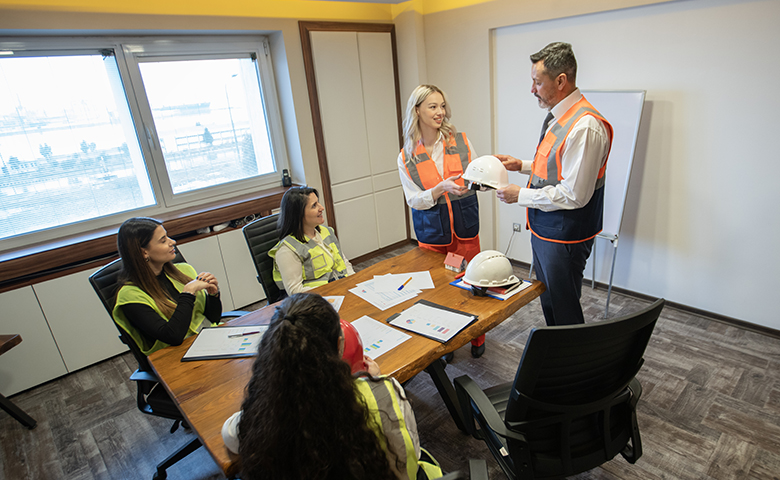
Businessman telling a SafeStart story before their meeting begins

Did you know the SafeTalk with SafeStart podcast has a regular story series?

The SafeTalk with SafeStart story series was designed as a tool that provides an alternative to analyzing your own SafeStart stories. Sharing stories is a crucial component of SafeStart, but it can be challenging to come up with the number of “fresh” stories required when you’ve been having your group share stories regularly.

Introducing stories from the SafeTalk podcast not only increases the volume of stories available to you, but it also expands the diversity of situations. These stories could also spark additional stories from people in your facility, and sporadically using the podcast could increase the number of volunteers with stories.

Each episode begins with a SafeStart story from a guest on the podcast. Listeners are prompted to pause the podcast in order to have a group discussion around the state-to-error risk pattern and critical error reduction techniques.

With close to 20 stories in our library, there’s bound to be a topic that relates to your audience, including:

Season 9, Episode 11: Story Series: Trouble on the Water
A story about launching a boat at a public boat launch ramp.

Season 11, Episode 8: Story Series: Turning the Tide: Deric Ostrum’s Vacation Rescue
Do safety professionals truly take vacations? This story is from a SafeStart consultant who prevented an incident for someone else on a cruise ship and what you can learn from this near miss.

Season 13, Episode 3: Story Series: Cooler Weather Brings Driving Hazards
A story about how cooler weather has wildlife on the move, underscoring the critical need for driver awareness and the application of SafeStart principles on the open road.

Season 13, Episode 10: Story Series: Combating Complacency with Safe Habits
A story about an employee working on their line-of-fire habit in the office and how their common near miss did not become a serious injury as a result of their new habit.

The topics are wide-ranging and include stories at work, off the job and on the road. You can find these (and more) podcasts at safestart.com/safetalk. Just search “Story Series” to find these episodes in our catalog—new episodes are continually added, so check back often.

On-demand webinar

Improving Culture, Safety and Performance with a 24/7 Approach

80% of injuries happen off the job but most workplace safety programs only apply during work hours. In this webinar, you will learn how a 24/7 approach can increase employee engagement during safety training, improve your safety culture, and positively impact your bottom line.

Watch now

Tagged , , , , , ,

Lone worker at a construction site weld metal structures of precast concrete slabs.

Lone worker safety is a perennial concern for every EHS manager who has at least one employee working on their own with any degree of regularity. Plenty can happen out in the field, and if an incident occurs, a lone worker needs to have the means to be able to call for help. They also need the appropriate training to know how and when to signal for aid if required.

As the National Safety Council points out, “working alone can increase both the likelihood of incidents and the severity of adverse outcomes.” Given the risks posed to lone workers, plenty of safety training is required to protect them from injury. And all sorts of technological devices exist to help monitor individual workers, and to keep them in contact with the rest of the company.

But these efforts aren’t enough to fully keep lone workers safe. Many factors contribute to the risk levels of employees working in isolation, and three of them—ambiguity, human factors, and communication skills—are all too often overlooked.

Ambiguity

When workers are on their own, do they know what they’re supposed to be doing throughout their workday? Just as crucially, do they know what not to be doing? And are they aware of how they should respond to a range of potential adverse incidents, from environmental changes and equipment malfunctions to serious injuries? Lastly, when things feel unsafe, do they know how to react? If the answer to any of these questions is “no” then that means workers’ safety might be affected by ambiguity—a lack of certainty in what they can do or how they should respond to a specific event—at dangerously inopportune times.

In theory, safety training should cover all these issues. But in practice, plenty of gaps can occur. Lone worker safety protocols often cover the major hazards that a worker might encounter in the field. But it’s less common to emphasize the extent to which workers can—and can’t—deviate from standard protocols.

Additionally, as safety expert Tim Page-Bottorff notes, “ambiguity can directly lead to elevated risk levels in several ways,” most notably when it comes to stop-work authority. Like any other employee, lone workers need to feel comfortable in refusing unsafe work. The barrier to doing so can be higher for lone workers, as it is often more logistically challenging to adequately address unsafe work conditions for remote workers. They also need to know how they can report unsafe conditions, which can be a challenge given the more complicated communications situation that lone workers face.

Human factors

Ambiguity is generally classified as a human factor because it’s on the list of mental and physical states that influence how workers perceive risk and act in the workplace. But there are plenty of other human factors out there, and they all pose a risk to lone workers.

Every single worker is affected by human factors like rushing, frustration, and fatigue, which can elevate the likelihood of an incident or injury. But most employees have co-workers and supervisors who can remind them to watch out for these factors or can help mitigate their effects. (Of course, that requires a proper human factors management program to be implemented first.)

Lone workers don’t have the benefit of reminders from others. They need to monitor themselves for signs of fatigue or rushing, for example, and then know which practical steps to take to account for these human factors. This makes effective human factors training particularly important for lone workers.

It also emphasizes the role of supervisory communication skills—because while lone workers don’t have someone looking over their shoulder while they’re working, they should still be in regular contact with a manager or supervisor. And with strong communications, that manager or supervisor can bring the dangers of human factors to the front of a lone worker’s mind.

Communication

It’s no secret that supervisors with strong communication skills can play a major role in workplace safety outcomes. Less widely recognized is just how vital these types of supervisors are for lone workers.

Often, a supervisor is a lone worker’s only point of contact. This means that all the information, key updates, changes to plans, and safety reminders that they receive come from a single source. As a result, supervisory skills have an outsized influence on lone worker safety. This is even more true once you account for a supervisor’s ability to reduce or exacerbate the effects of ambiguity and other human factors.

The major takeaways here are that after baseline safety training, lone worker safety programs should focus on improving the skills and knowledge of both remote employees and their supervisors. By implementing human factors training and honing supervisory communication abilities, EHS managers can reduce the impact of the hidden risks that put their lone workers in danger of potentially serious incidents.

On-demand webinar

Safety and the Supervisor: Developing Frontline Leadership Skills to Improve Safety

Supervisors are the bridge between organizational directives and on-the-ground operations. Their skills and knowledge are critical to a seamless flow of information in both directions and to their organization's safety success. This webinar offers EHS managers and company executives actionable advice on improving safety through leveraging the role of frontline leaders.

Watch now

Tagged , , , ,

If you found yourself anywhere near a radio in the ‘90s, chances are you’ve heard the opening line—Stop! Collaborate and Listen—to Vanilla Ice’s hip hop megahit, “Ice Ice Baby.” It’s not just a catchy way to start a song—it’s great safety advice, too. Collaboration is essential in making sure a workplace is keeping human factors in check, communicating clearly and aligning technical and people systems with reliable outcomes.

In a presentation at the Safety on the Edge conference (held March 26, 2025), safety thought leader Tim Page-Bottorff illustrates this three-step approach to teamwork by looking at the example of a non-emergency chemical spill. In workplaces that use hazardous chemicals, non-emergency spills can occur and need to be cleaned up properly. With the correct systems in place—like ventilation, PPE, and instructions and training on how to treat spilled chemicals—a workforce should theoretically have no trouble responding to a non-emergency chemical spill. But human factors like fatigue, rushing, frustration or complacency can contribute to the individual losing track of or ignoring systems that are in place to help mitigate the hazard. An individual might not have the information they need to make informed decisions on how to act. These issues can lead to folks taking shortcuts, making assumptions or even ignoring the hazard.

So when the spills aren’t being cleaned properly, it’s time to take a page out of the Vanilla Ice playbook. Here’s how:

STOP

When a worker, supervisor or safety professional notices something is out of tune, they should stop. Stopping allows you to assess the situation and head off unproductive responses like blaming someone. By stopping, workers have a chance to address their own internal factors and thoughts—so they can make sure they aren’t rushing or frustrated before they start to work with others for a more favorable outcome.

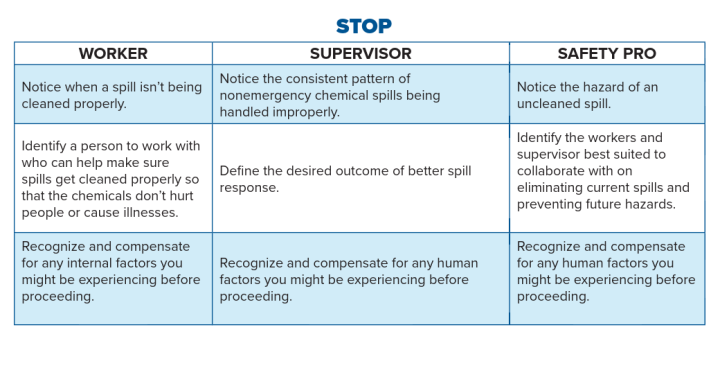
In the non-emergency chemical spill example, stopping can look like this for workers, supervisors and safety professionals:

STOP worker supervisor safety pro

COLLABORATE

After taking a moment to stop, it’s time to engage with someone who can help achieve a better outcome. Collaboration starts with a commitment: put the goal of safety first and understand that the best way to achieve that goal is by working together.

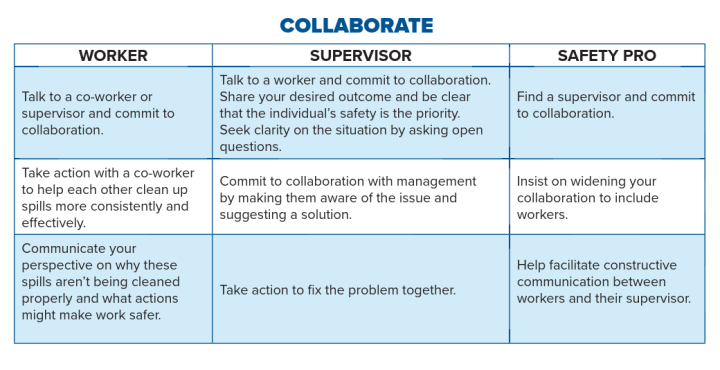
Here’s how that looks in our non-emergency chemical spill scenario:

COLLABORATE worker supervisor safety pro

LISTEN

A person’s commitment to collaboration needs to be maintained and that requires listening to teammates. A sustainable collaboration that supports a positive outcome is one in which people are listening to each other and adapting accordingly. Listening is how people can keep everyone synced up throughout an ongoing collaboration. Listening can also help supervisors gauge how successful a collaboration was after a task has been finished—listen for signs of people’s positive or negative experiences with the outcome. This can help improve future collaborative efforts.

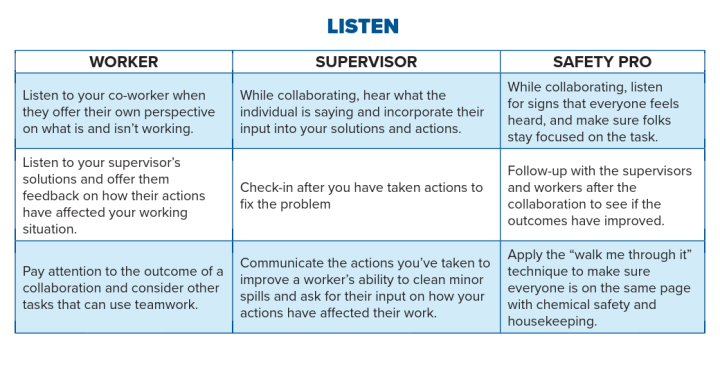
Here is what that looks like for different roles in our non-emergency chemical spill example:

LISTEN worker supervisor safety pro

This three-step process—stopping, committing to collaboration and listening—can be transposed to any workplace scenario you face. And the best part is that other soft skills and culture-building leadership techniques can further enhance this method. So next time you face a challenge at work, remember that you’re not alone: just stop, collaborate and listen.

On-demand webinar

Humor in Safety

Safety presentations can be yawn-inducing torture—but they don’t have to be. Humor in Safety helps you make safety training more effective with practical tips on the importance of storytelling, how to be more relatable and reframing the training topic to make it more engaging.

Watch now

Tagged , , , , ,

Are You Ready for Tornado Season?

Keep your eye on the sky, it’s tornado season. And if that sounds a little preemptive—after all, the most active month for tornadoes is typically May, averaging 294 tornadoes a year in the U.S.—then this blog post is for you. Everything we thought we knew about tornadoes is changing, from the time of year they occur to the areas where they most commonly happen. It’s time to shake off tornado complacency built up by past experience and adapt to the new reality of these windy catastrophes. Everyone should be prepared and know what to do in case of a tornado, and we’re here to help.

What is a tornado?

First, let’s start with the definition of a tornado, also known as a twister. According to National Geographic, “A tornado is a violently rotating column of air that extends from a thunderstorm to the ground.” That violent air column is usually a revolving cylindrical shape referred to as a funnel. And when the twister touches down, it wreaks havoc. This destruction is not limited to leveled buildings, ruined vehicles and uprooted trees—people can also be swept away.

The winds of a tornado may reach speeds of up to 300 miles per hour. And when it comes to severe weather phenomena, these furious funnels are about as dramatic as it gets. A tornado is like a villain in a comic book: often backdropped by a greenish-colored sky, they are unpredictable, they get their power from a thunderstorm, they can throw hail and they have a terrifyingly loud roar. They can’t be overpowered. They can’t be outrun. When a tornado descends, everyone should seek shelter, preferably indoors.

Tornado season

While March to June has historically been defined as tornado season, researchers have found that warm-season tornadoes have declined by 37% and there has been an increase in tornadoes in the cold season. But tornadoes can happen at any time of year, and while most tornadoes occur in the late afternoon and evening, they can also happen at any time of day or night. That level of unpredictability means that there’s no bad time to brush up on twister preparedness, especially since there has also been a spatial shift in where tornadoes typically occur.

Tornado Alley

Tornado alley (sometimes called tornado valley) is not one particular location but rather a loosely defined area in the central United States where tornadoes are most frequent. Specifically, tornado alley has been identified as northern Texas northward through Oklahoma, Kansas and Missouri, as well as parts of Louisiana, Iowa, Nebraska and eastern Colorado. But there’s evidence that suggests tornado alley may be expanding beyond the Midwest, shifting eastward—marking eastern Missouri and Arkansas, western Tennessee and Kentucky, and northern Mississippi and Alabama as the new tornado corridor.

According to Scientific American, the trend of cold-season tornado activity in the expanded tornado alley was on bleak display in 2023, when a “violent twister with wind speeds of 170 miles per hour struck Rolling Fork, Miss., on March 24, killing at least 26 people. A week later, storms in the new tornado alley killed more than 30 people, and another group on April 4 damaged more than 80 structures in Bollinger County, Missouri.”

Check your area to see when the last tornado touched down—you might be surprised to learn twisters are more common than you thought in the area where you live. After all, tornadoes have been reported in all 50 states!

Tornado watch or warning

If you’re not used to hearing tornado watches or warnings in your area, you may not know what to do when the weather alerts start coming in. A tornado watch is often issued to signal that a severe thunderstorm capable of producing a tornado is in the area—be prepared. A tornado warning is issued when a rotation in the clouds or a funnel cloud has been spotted or indicated by radar and there is a serious threat to life and property in the path of the tornado—seek shelter. A tornado emergency is the National Weather Service’s highest alert level. This is issued when a violent tornado has touched down in a watch area and a severe threat to human life and property is confirmed.

These scenarios can escalate very quickly, so when it comes to tornadoes, every second counts. Take shelter immediately when you learn of a tornado warning in your area. Your workplace should have a plan in place for every type of emergency, but it’s important to have a personal plan and go over scenarios for how to react to a tornado, regardless of where you are.

Here are some checklists that can help you stay safe at work, at home, outside or on the road.

What to do at work
  1. Follow the instructions of the personnel in charge of the emergency plan.
  2. If there isn’t anyone overseeing the emergency, go to the basement or the lowest level of the building, either in the hallway or a room in the middle of the building (preferably without windows).
  3. Make yourself as small as possible by crouching down.
  4. Use an object or your arms to protect your head and neck.
  5. When possible, get under a piece of sturdy furniture like a desk and hold on to it.
  6. Do not use elevators. If the power fails, you can get trapped inside.

Note: Buildings with long-span roofs (exceeding 12 m), such as manufacturing plants, warehouses, shopping malls, theaters or gymnasiums, are especially dangerous during tornadoes because the roof structure is supported solely by the outside walls. If this is the type of roof you’re under, try to get to a lower level or find a more secure structure to take shelter in.

What to do at home
  1. Go to the lowest level of your house—the basement or a storm cellar if possible.
  2. If there is no basement, go to a room in the middle of the house, preferably one without windows, and remain in the center.
  3. Stay away from windows and keep them closed—despite popular myths, opening the windows during a storm will not equalize the pressure and can cause more damage.
  4. Avoid taking shelter directly beneath an area with heavy objects on the floor, like a refrigerator or piano. It is possible for these objects to fall through the floor during a tornado.
  5. Make yourself as small as possible by crouching down.
  6. Use an object or your arms to protect your head and neck.
  7. When possible, get under a piece of sturdy furniture like a heavy table and hold on to it.
  8. A bathtub is a safe location during a tornado if the bathroom is deep inside your house and doesn’t have any windows. Note: If the wall of the bathroom is exposed to the outside (or the bathroom has windows), the bathtub is not an ideal place to shelter.
  9. If you live in a mobile home, seek shelter elsewhere.
What to do if you’re outside
  1. If possible, get inside a sturdy building and follow the instructions in the previous lists that are most appropriate to your type of shelter.
  2. If you’re unable to find a sturdy building to take shelter in, stay close to the ground, preferably in a ditch or low-lying area.
  3. Make yourself as small as possible by crouching or lying down in a ditch.
  4. Use an object or your arms to protect your head and neck.
  5. Watch out for flood waters that fill low-lying areas.
  6. If there is a strong building (reinforced concrete buildings like a school) nearby but you’re unable to get inside, crouch as close to the structure as possible and take cover.
  7. Tornadoes can change direction quickly and will toss things through the air. Be aware of your surroundings if you’re stuck outside.
  8. Avoid areas with a lot of trees.
What to do if you’re in your vehicle
  1. Park and get out of the vehicle.
  2. Refer to the “What to do if you’re outside” instructions.
  3. You can’t outrun a tornado, so do not attempt to beat or “drive out” of the storm.

Even after you’ve refreshed your tornado safety knowledge, it’s important to stay sharp. Perhaps you have heard there’s a tornado watch for days and you’ve become complacent to the risks, thinking nothing bad is going to happen because up to this point, it hasn’t. Stay as vigilant as possible throughout the entire tornado watch.

And don’t forget to spread the word to keep complacency at bay for your workers. Print these guidelines or incorporate them into a toolbox talk to ensure that your employees are safe in the event of a tornado, no matter where they are or what they expect this time of year.

On-demand webinar

Using a Human Factors Framework for Safety and Operational Excellence

It can be hard to see the connection between safety, productivity, human factors and organizational systems. This webinar will demonstrate how a human factors framework can impact all areas of an organization, linking individual worker safety and organizational systems and provide an outline that allows leadership to manage safety-focused change.

Watch now

Tagged , , , , , , , ,

female engineer on the top of a construction site

No matter how much experience a new worker has at other companies, changing employers requires a new hire to figure out how to navigate new tasks, new hazards and a new culture. They also need to develop a feeling of comfort in refusing unsafe work, speaking up about safety issues, and they must also learn how they should share their concerns.

With such a steep learning curve, it’s no wonder why new workers are injured at such high rates.

Reducing the risk of injury requires safety professionals to speed up the learning process that all new hires go through. It requires a proper safety orientation, establishing a sense of trust and psychological safety, and it requires support and monitoring.

In short: it requires getting the first 90 days right.

Safety consultant Larry Pearlman is an expert in new worker safety, and he says that an employee’s first 90 days on the job are crucial:

“There are a few big things that companies need to get right during a worker’s first three months on the job. They need to set safety expectations, they need to train people to get them up to speed, and they need to demonstrate a certain level of care for the new employee. That requires doing all sorts of little things right to improve risk awareness, build trust, and reinforce safe behaviors. However a worker’s first ninety days go, either well or poorly, it will set the stage for the future attitudes towards safety and their relationship with their employer.”

Here are some of the foundational components of a successful and safe first 90 days on the job:

Safety onboarding

New employees should be given the same safety training that everyone else has already received. It’s a basic concept that all too often is not put into practice.

According to research conducted by the Institute for Work & Health, only one out of five new workers remember receiving safety training. In some cases, employees simply don’t receive safety training in a timely manner. A subset of these cases is when employers hold back on delivering expensive or time-consuming training until after the probationary period and after they see whether the person is going to “work out” and stay long-term. (This is a particularly ineffective tactic, as by the time employees are deemed worthy of safety training, they will have already received the message loud and clear: financial considerations are more important than safety, and it may be time to look for another job that cares as much for people as production.)

In other cases, new hires receive training but it isn’t delivered effectively, to the extent that workers simply forget what is taught to them. In both cases, the effect is the same—inexperienced employees navigating an unfamiliar workplace without the benefit of safety training.

Just how effective is safety onboarding? Scott Schneider, director of occupational safety and health at the Washington-based Laborers’ Health and Safety Fund of North America, points out that on union sites “people have a substantial amount of safety training in apprenticeship programs” which results in fewer safety problems and better communication. This package of training and mentorship goes a long way toward mitigating the risks associated with being a new worker.

All told, the quality of safety onboarding has a direct impact on injury outcomes. A robust safety onboarding process should include:

  • An overview of safety processes, procedures and equipment
  • A review of site-specific risks and mitigation strategies
  • An introduction to the company’s safety culture
  • A discussion of the right to refuse unsafe work and the stop-work authority process
  • The correct process for reporting injuries, near-misses and emergencies
  • Risk assessments and other pre-job evaluations
  • Any additional safety training that existing workers have received

As the statistics from the Institute for Work & Health demonstrate, it’s not enough to teach people these things once. You have to teach them, reinforce what they learned, give them opportunities to practice, and then monitor and correct them in the workplace as they deploy what they’ve learned. Otherwise, you’ll risk being one of the 80% of workplaces where new hires don’t recall their initial safety training.

Risk awareness

Almost every hazard is conditional. Come into contact with a power line and it’ll zap you every time—unless the electricity has been shut off. Knowing when, where, and why something is dangerous is one of the core features of workplace safety. And a big part of hiring new employees is improving their risk awareness and situational safety skills.

In some cases, this is a matter of educating them on standard safety processes. New hires can learn to recognize the risk of working on a large piece of equipment, for example, based on whether it’s been locked and tagged out.

They can also be taught about site-specific hazards such as an area of a construction site where truck drivers tend to drive faster than they should, or where visual obstructions or distractions might reduce a driver’s ability to notice someone on foot.

These are examples of on/off types of risk: The risk is higher over here and lower over there. The risk is absent when there’s a tag on the equipment and the risk is present when there isn’t a tag. Hazards like these abound in the workplace, and it’s important to familiarize new hires with them. Because, as noted earlier in this guide, many people have a hard time noticing even obviously fatal hazards on their own.

What’s even trickier is a risk that fluctuates in real time. A walkway might become a little slippery as it rains and then increasingly so as the weather worsens. Or a worker may become more tired—and clumsy and forgetful as a result—towards the end of the shift or the end of the week. These types of risks occur on a sliding scale, and new workers can find it challenging to stay aware of sources of risk that are constantly changing.

Human factors are the most notable form of fluctuating risk, alongside shifts in the working environment due to the weather or the nature of the work (such as a walkway filling with trip hazards over the course of the day). Educating workers about fatigue, rushing, distraction and other human factors can be tricky, especially if this is the first time that new hires have ever thought about risk in this way.

It’s often best to rely on a third party to train them on this sort of thing, given the sizeable list of education required for new hires. But whether you’re doing it yourself or relying on a vendor, make sure that you’re including risk fluctuations as part of your risk awareness training.

Don’t forget about the need to provide reminders about these hazards. No one shows up to work trying to get injured, but no one has a perfect memory either. Learning takes time and support, especially if new hires used to work at companies that didn’t value risk awareness skills.

This blog post is an excerpt that was adapted from the EHS guide Fitting in Fast: Making a Safe Workplace for New Hires, which reviews the best ways to protect new workers in their first months on the job. Download it for tactics to protect new hires from being hurt in the workplace.


On-demand webinar

Using a Human Factors Framework for Safety and Operational Excellence

It can be hard to see the connection between safety, productivity, human factors and organizational systems. This webinar will demonstrate how a human factors framework can impact all areas of an organization, linking individual worker safety and organizational systems and provide an outline that allows leadership to manage safety-focused change.

Watch now

Tagged , , , , ,

Man with headphones working on a laptop and taking notes on paper

On-demand webinars are a great way for people to learn at their own pace and on their own schedule, and they can also revisit the information as often as needed afterward. SafeStart has developed a library of on-demand webinars on various topics to fit that need. 

But we’ve taken it one step further—we also have a list of presentations from our SafeStart clients that may interest you since their area of focus is their success with SafeStart. The audience for their initial presentations was SafeStart staff. These presentations were originally presented in a lunch-and-learn format and we have edited them to include the recordings as a resource for other clients. We like to think of these as a different type of case study—a success story in a different format. The pre-recorded presentations are available here.

SafeStart and SafeLead are designed to complement any existing safety management systems companies have in place. And SafeStart and SafeLead have different user experiences. Steve Crider, the Safety & Compliance Officer for RedGuard, talks about how various applications and principles can work together to improve overall safety. Read more about Steve’s presentation or check out the full presentation. 

Ken Tutin, Vice President of Business Support for the Americas Division of Crown Cork & Seal USA, Inc., delivered his lunch-and-learn presentation about how his company has turned around its safety record. Ken acknowledged that there’s still work to be done, but he shared a game-changing equation for safety leadership success. The equation is broken down in this blog post, or you can watch the full presentation to hear how it will reach breakthrough injury reduction.

Ed Stephens, Global HSE/SA Audit, Assurance & Senior Lead Investigator of ABB Robotics and Discrete Automation, sat down with SafeStart’s Chief Client Officer Don Wilson for a lunch-and-learn session to discuss Ed’s success with collecting employee frustrations, or as they call it, harvesting frustrations. It has become an integral part of their organization’s success in human factors management. Read more about How to Turn Frustrations Into Safety Preventive Measures or watch the presentation here. 

Another lunch-and-learn focused on “upset systems,” as High Liner Foods‘ EHS Director Erika Pouliot explained. The presentation essentially showed instances when rushing and frustration took over on the lines at High Liner, causing workers to focus more on production than safety and ultimately resulting in a number of safety incidents.  And it was due to the message being more focused on the high cost of fish “and so they’re starting to hear that the numbers are more important than people, and the focus is more on the numbers and not on their safety,” said Pouliot. This presentation shows how a human factors approach helped to eliminate recordable injuries due to upset systems. Read a little more in the blog post or watch the lunch-and-learn presentation on demand. 

SNF Chemtall’s Safety and Training Supervisor Devron Kelso demonstrated some techniques borrowed from the world of guerrilla marketing to engage the workers at his facility. In his presentation, Kelso defines guerrilla marketing as “an advertising strategy using surprise and/or unconventional interactions to promote something.” It’s about embracing your creativity. From corporate street art to rapping and music videos, Kelso uses the guerrilla marketing philosophy to find new ways to promote safety. You can read more about his session in this blog post, or watch the presentation for the full effect. 

As stated in our 5 Repeatable Patterns for Safety Success Guide, “Safety is not a trade secret. Sharing best practices prevents the redundancy and repetition of effort that accompanies the trial and error method. There is no threat to sharing these practices. Most companies would love nothing more than to rely on tested methods from trusted sources to skip the leg work, because who wants to gamble with the lives of their employees?” 

Most of our SafeStart clients come to us after hearing first-hand accounts from people who achieved results from their implementation. These are just a few examples of the clients who have shared their successes with us in lunch-and-learn presentations. Take advantage of the free learning opportunities from all of our on-demand webinars.

Guide to Safety Patterns

5 Repeatable Patterns for Safety Success

SafeStart has worked with tens of thousands of safety professionals over the last three decades and this guide summarizes the common problems they all have and what you can do to ensure you have success in safety.

Get the free guide now

Tagged , , , , , , , , , , , ,

group of diverse workers raising hands to celebrate project success

If you asked a hundred people what the primary benefit of safety training is, you’d likely hear the same answer a hundred times: preventing injuries and saving lives. After all, there is a massive and obvious need to keep people safe.

There are many reasons for this unanimity, starting with a moral imperative: keeping people alive and healthy is just the right thing to do. But there are also financial benefits to protecting your people. Over half of injuries involve “days away from work, job transfer, or restriction”, according to Insurance Journal, and there’s a real cost to these disruptions to the workforce. It’s also long been noted that the level of workplace compensation claims can have a massive impact on an organization’s bottom line. A safety program that effectively reduces injuries can be a net positive contributor to company profits.

While saving lives and reducing injury-related expenses are the two clearest positive outcomes of safety, they’re hardly the only ones, and the benefits of training reverberate far beyond incident rates and insurance claims. Here are three commonly overlooked benefits of quality safety training initiatives.

Employee engagement

Every employer is happy when a shift ends without an injury. But do you know who really likes a day without an incident? The employees themselves.

When people see injuries happening around them, or when they experience an injury, it can be a massive de-motivator. After all, who would feel enthusiastic about working in a setting that appears to be dangerous? The opposite is also true. When employees feel like their workplace is a safe one, they’re more likely to be engaged in their day-to-day tasks.

Safety is one of the primary ways that companies can demonstrate a high degree of care for their employees. And that sense of care is often reciprocated when employees are more attentive in their daily tasks and more engaged in the workplace.

Employee engagement can also generate a positive feedback loop. As safety researcher Rodd Wagner notes, “Safety is one of the most reliable outcomes of employee engagement … Happy employees are better at keeping themselves and their colleagues out of harm’s way for reasons both conscious and subconscious.”

Safety can be used to make employees more engaged and happy. And employees who are engaged and happy will be more attentive and even safer. It’s a safety-engagement cycle that EHS directors dream of. And it all starts with effective safety training.

Stronger culture

It’s widely believed that a strong safety culture can have a positive impact on safety outcomes—and that’s backed up by a significant library of research on the relationship between safety culture and safety performance. But it’s worth noting that, just like we saw with employee engagement and safety outcomes, the connection between safety and culture is a two-way street. EHS professionals can use this to their advantage.

As a recent white paper on safety climate notes, small safety initiatives can be a catalyst for wider cultural change, with the paper noting that “creating improved safety and communication on a small scale within teams and departments can perhaps counterintuitively lead to faster and more sustainable gains [in organizational culture].” And so while many people think that safety is influenced by culture—and it often is—it can function the other way, too.

Culture isn’t something that shifts overnight. Instead, it works like compound interest, slowly but steadily accumulating over time. An initial safety deposit can seem small but—allowed to compound over time and, hopefully, with additional deposits down the road—it can amount to a sizeable culture shift.

Safety columnist Ray Prest argues in Occupational Health and Safety magazine that safety culture is “the result of established procedures and processes, the efficacy of training plans, the strengths and weaknesses of supervisors as well as the individual abilities and mental states of a whole bunch of workers, plus many other factors. It’s a classic example of the sum being equal to the parts, and then some.”

Improving the efficacy of training plans can lead to a stronger culture. And that, in turn, can pay safety dividends for years to come.

Cost savings from the frontline to the HR department

Injuries are a lot more expensive than many people think. Yes, they can lead to costly workplace compensation claims, but there are many other indirect costs related to lost-time injuries. There is reduced productivity as seasoned employees are swapped out for inexperienced replacements. There is a negative impact on quality. Injuries also reduce employee engagement, which further reduces the speed and quality of employees’ work. High injury rates can also elevate worker turnover—and having to hire and train replacements is an expensive proposition.

The opposite is also true. Reducing injuries can improve workplace retention, improve the quality of production and improve engagement. These upgrades can lead to major financial savings. They can also lead to time savings in the HR department. With less hiring to do, fewer complaints to deal with and a downturn in compensation claims, human resources professionals will happily take note of the downstream effects of an effective safety initiative. The effect can be so pronounced that you may even be able to use these human resources benefits to help get buy-in for safety training and other EHS initiatives.

The big caveat about extra safety training benefits

Not all safety training offers these benefits. So before you start anticipating big savings, better engagement and a happier HR manager, make sure that you know whether you’re likely to see these additional perks of safety training.

Mandatory training is unlikely to move the dial on engagement or culture. Annual fire drills, forklift certifications and other required refresher sessions won’t work either. These types of training initiatives are often perceived by employees as check-the-box exercises and, after years, many workers will have become complacent with them.

Voluntary training is much more likely to reap these extra engagement, culture and cost benefits, especially if that training looks visually appealing and is designed with adult learning principles in mind. Having the safety training delivered by a professional safety consultant can also go a long way to getting more secondary value out of each session.

Well-crafted training will make a point of helping employees recognize how they personally benefit from the education sessions and will give companies an easy way to demonstrate genuine care for their workforce. This is especially true for initiatives like human factors training that gives employees practical skills that boost their personal awareness. This type of training can also create a common language and lay the foundation for a stronger culture.

So the next time you’re considering a new safety implementation, take some time to chat with the training provider not only about injury reduction but about secondary benefits like engagement, culture, financial savings and even a positive impact on HR. Choose the right program and you’ll be sure to see the positive changes that can take hold when you put safety first.

On-demand webinar

An Expert Look at Employee Engagement and Safety

Without employee engagement, even compliance can be hard to achieve. This webinar, with insight from experts, was created to help busy professionals find the right approach to increase engagement in safety. The accompanying resources aim to help you apply this new knowledge and continue learning about the subject.

Watch now

Tagged , , , , ,

New Hire Orientation PPE Review

Every year, millions of people are hired to fill vacant positions at companies across North America. Some of them are starting their first job, others are shifting to a different role or company, while still others are changing careers entirely. In the last twelve months, twenty industries were projected to have at least 84,000 new hires, with jobs ranging from electrical and construction workers to truck drivers and order fillers.

The one thing every single new hire has in common is that they are at an elevated risk of a workplace incident. Approximately one in every three workplace injuries occurs to a worker in their first year on the job. And as an article in Occupational Health and Safety magazine titled “The Safety Stakes for New Hire Onboarding” says, this is a problem that affects both young and experienced workers alike. It notes that: “Regardless of age or experience at other jobs, newness to a workplace is a massive contributing factor to injury risk. When someone shows up for their first day, they show up with their lunchbox, a bounce in their step and a sky-high chance of getting hurt sometime in the next twelve months.”

New workers are at risk for a number of reasons. They won’t have first-hand knowledge of the various sources of hazardous energy in the workplace. They will be unfamiliar with safety procedures. And they may not feel comfortable asking questions if they’re uncertain about something, or may be unwilling to exercise their stop-work authority when they feel a situation is unsafe.

A good safety onboarding process can mitigate these issues. But it can still take time for employees to integrate into the company’s safety culture. And with so much to learn at a new job, some key safety information may not be retained when it’s first taught.

The article points out that “it’s up to safety professionals to ensure there are established steps to repeat, reinforce and reiterate (and did I mention repeat?) key information.” A good safety orientation is an important step but it requires a lot of follow-up to ensure that new hires understand what they’ve learned.

While there’s a lot to do in an employee’s first weeks and months on the job, taking a safety-first approach to bringing new hires into the workplace can have a huge impact on safety outcomes. As the article says: “It takes time and effort for safety professionals to properly train new employees on key safety issues, discuss the human factors that can make their jobs more dangerous, and integrate them into the workplace culture. But when these things happen, new hires have a much better chance of staying safe in the first year on the job.”

The lesson here for safety professionals is to be as involved as possible in new hire orientation and to treat onboarding as an ongoing process. Because ensuring that new workers are properly trained, supported and integrated into the workplace safety culture may end up preventing a serious injury—or worse.

Guide to New Worker Safety

Fitting in Fast: Making a Safe Workplace for New Hires

Protecting new hires is a huge safety challenge. How you introduce them to your company’s culture will dramatically affect their immediate safety and instill shared responsibilities for positive outcomes in the future.

Get the free guide now

Tagged , , , , , ,

Worker perplexed on the job

Not all new workers are the same, but they do have a lot in common.

They lack relevant experience in the workplace they’re at, with the task they’re doing and/or with the team they’re on. They lack crucial hazard recognition abilities. Often, they don’t know what they don’t know.

They are, as OSHA says about young workers, more susceptible to stress resulting from the fact that they “might not receive adequate in-person training and mentoring, and they may feel confused about their job duties and expectations, unsure where to go for guidance, and concerned they will not perform well.”

They might not understand their right to refuse unsafe work. They might not be able to recognize unsafe work in the first place. Or they might feel reluctant, for any number of reasons, to speak up if they feel like a task is dangerous.

They will be slower while they’re learning, which often means they’ll have to rush to keep up with the workflow. Their new job will also be more cognitively and physically demanding than it is for more experienced employees, leading workers to be more tired and less able to respond appropriately to unexpected events in the workplace.

They’re also missing the three C’s: common language, cultural awareness, and the concept of human error and managing human factors.

Put these all together and it’s clear that most new workers are at a greater risk of injury because of the same issues. And three of these safety concerns stand head and shoulders above the rest: hazard recognition, stop-work authority, and the three C’s. The three C’s of new hire safety are such a big issue that we’ll have to deal with them separately. Here, let’s take a closer look at the other two: recognizing hazards and stopping work when it seems unsafe.

Hazard recognition

Some hazards are easier to spot than others. No one needs to be told that it’s a bad idea to step in front of a forklift in motion. But even obvious hazards can have major blind spots: Is there likely to be a forklift driving just around the corner? Does the organization follow all the best practices for powered industrial truck safety? Long-tenured employees will know, but new hires won’t.

And while some hazards may seem obvious, they’re actually anything but. A recent study of companies in the construction sector—the industry that is publicly recognized as having the most workplace fatalities —found that workers could only recognize hazards that contribute to the Fatal Four construction deaths 57% of the time. This means that over 40% of the time, workers failed to spot something that is widely known to be life-threatening to them.

The statistics get even more grim when you look beyond the Fatal Four. Over half of gravity, electrical, motion, and temperature hazards went unrecognized, and workers were able to identify pressure, chemical, and radiation hazards less than 10% of the time.14 This study includes all employees and not just new workers. So imagine how much worse the ability to recognize hazards must be for new hires—especially for new hires in industries where the dangers are less obvious than in construction!

What may seem obvious to a seasoned safety professional can be imperceptible to a new hire. This is especially true for idiosyncratic, unusual or it-just-works-this-way-here types of hazards. Many workplaces have them, and they need to be taught to new hires.

No one shows up to work wanting to be injured. But then, no one shows up to a new job knowing what will injure them either.

Stop-work authority

Stop-work authority is one of the pillars of workplace safety. It’s an especially important measure for new workers who are most likely to feel the need to halt work because they feel uncertain or unsafe.

There are two critical components to stop-work authority: a worker’s recognition that it exists, and a worker’s comfort and willingness to make use of it. And that’s a problem when it comes to new workers.

As one insurance company says: “They may also be less aware of their rights and responsibilities related to safety and feel less comfortable notifying their employer about hazards or unsafe conditions.” 15

Rodd Wager is a New York Times bestselling author and a member of SafeStart’s assessment and diagnostics team, where he looks under the hood at organizations’ safety performances. This gives him a unique vantage point of how workers view stop-work authority. And according to Wagner, an unfortunately high number of workers don’t feel comfortable exercising that right. Here’s how he puts it:

“Most industrial firms grant universal stop-work authority; anyone who sees the elements of an accident or serious breakage coming together is empowered to shut down operations. It’s fair to assume most managers believe their staff will use that explicit authority when it’s needed.

Yet to the statement “I feel empowered to stop a job at any time if I am concerned about unsafe conditions,” we usually see about 15 percent of workers answer “Neutral,”“Disagree,” or “Strongly disagree.” And at one company where everyone got a stop-work authority red card sized and punched identically to their work badges, three in 10 frontline workers were neutral or disagreeing.

Many of those reluctant to invoke their red cards don’t believe their supervisors really mean it; they believe their employers give lip service to the policy but prefer that everyone keep the machinery running, if at all possible.

Instilling a belief in management’s commitment to stop-work authority is paramount. So is educating workers on when, where, why and how to exercise their right to pause work if they feel unsafe. It takes more effort than you may think to get new hires to understand and buy into the stop-work process—but it’s one of the most important steps in bringing a new employee into the workplace.

This blog post is adapted from the safety guide Fitting in Fast: Making a Safe Workplace for New Hires, which examines the ins and outs of how to keep new workers safe as they join the workforce. Download the guide today to discover key practices to protect new hires.

Guide to New Worker Safety

Fitting in Fast: Making a Safe Workplace for New Hires

Protecting new hires is a huge safety challenge. How you introduce them to your company’s culture will dramatically affect their immediate safety and instill shared responsibilities for positive outcomes in the future.

Get the free guide now

Tagged , , , , ,

GenZ working on electric boiler

By now it’s no secret: young people are choosing to work in the trades. Motivated by social media trends from work-themed influencers and the numerous advantages that come with trades work, Generation Z—people born between 1996 and 2006—are on track to join the workforce. Dubbed The Toolbelt Generation in a 2024 The Washington Post article because more young workers are going into the trades, this wave of young employees is coming just in time. Baby Boomers are entering retirement age, which means many organizations are going to need to restaff over the coming 5–10 years. GenZ is training up, ready to work and poised to keep operations rolling smoothly.

This surge of new young workers has a lot of potential to reinvigorate workplaces and preempt staffing shortages. But they also bring with them their own unique safety challenges. You want to make sure you’re ready to protect the Toolbelt Generation, and that starts at the front door on their first day.

It’s not easy being green

While it’s tempting to treat every incoming generation as unrelatable, strange and novel, the fact is all new workers face many similar dangers. In their first year on the job, workers experience a disproportionate number of injuries compared to their more experienced coworkers. The same goes for workers under 25, which currently describes GenZ, and was also true for Millennials and GenX before them.

To illustrate this, consider these stats collected in the new guide Fitting in Fast: Making a Safe Workplace for New Hires:

The solution, as proposed in the guide, is to focus on the onboarding process for all new hires. Getting the first 90 days right can set the tone for the rest of an employee’s career. And taking the initiative to welcome newbies is a great way to improve your overall workplace culture. Which is important when we focus more specifically on the Toolbelt Generation.

Talkin’ ‘bout my generation

Generation Z came of age during a time when ideas about identity, work-life balance, communication and autonomy all shifted. As such, the Toolbelt Generation has priorities that need to be recognized if you want to retain their employment and keep them safe. As indicated in a survey from UKG, 71% of GenZ frontline workers report that they might quit their jobs because of negative interactions with managers, coworkers or customers.

Psychological safety is a priority for GenZ, who statistically report the highest levels of burnout compared to other generations. They prioritize having a sense of purpose at their work, and prioritize personal time and flexibility over financial progress—the UKG survey shows that over half of surveyed Toolbelters would rather have more vacation time than a pay increase.

These priorities have implications for safety. Burnout causes sustained fatigue, which leads to critical errors responsible for injuries and deaths not just at work, but on the road. The National Safety Council estimates that 6,400 people die in crashes involving drowsy driving every year, and numerous studies have shown a link between work stress, burnout and traffic crashes among a range of occupations from bus drivers to teachers to healthcare workers.

Meanwhile, the fact that many would quit a job after a negative interpersonal interaction indicates that a poor workplace culture may contribute to human factors like frustration, anxiety and apathy more significantly with these youngest workers.

Ushering in a safety generation

In addition to ensuring your workplace has a comprehensive and inclusive onboarding program, there are a number of ways you can help transform your work culture to protect and retain GenZ workers.

Battle burnout – A new study shows that the average worker spends more time working than they do sleeping. Take steps to encourage exercise—physical activity is a known fatigue fighter. If your workplace offers flex hours, make sure your new workers are aware of how they work. And when it comes to any incentives you have in place, consider (if possible) offering vacation hours as an option instead of monetary bonuses.

Fight frustration – The GenZ desire for flexibility and aversion to conflict makes frustration a high-stakes game when it comes to keeping young workers working. As a human factor, frustration can be pre-empted with proactive communication. Make sure you’re doing everything you can to make your employees aware of changes in the workplace through toolbox talks and digital display presentations. And rather than assuming a new worker will want what their older coworkers prefer, be sure to reach out on matters that concern them, like their goals with work and their professional priorities.

Address ambiguity – Another benefit of clear communication is that it counteracts ambiguity, which is a multi-pronged threat to GenZ workers. Ambiguity thrives in situations where preexisting knowledge is assumed, and if a worker is conflict-averse they are more likely to do a task without asking for help. This can lead to processes being done incorrectly, and it can also put folks at risk of injuries or worse. Checking in with young workers by asking them to walk you through a task is an excellent way to acknowledge them as individuals while engaging in what they are doing and dispersing any ambiguity.

Engage enthusiastically – Demographic surveys and studies can only tell us so much about the people we work with, so it’s important to engage with new workers before acting on assumptions. Statistics are great for understanding broad trends, but when it comes to understanding what’s going on with an individual worker—from their expectations to the human factors they may be experiencing—the best way to proceed is by showing personal commitment through active engagement. Check in with young workers, ask them questions and engage them in storytelling. Getting to know people as individuals helps keep everyone safe.

The ingress of Generation Z workers has already started, and it is forecast to become a wave of change. And that’s a great opportunity to review and renovate your safety culture for the better. Take the steps to connect and protect these young new workers to play your part in raising the Toolbelt Generation to be a Safety Generation.

Guide to New Worker Safety

Fitting in Fast: Making a Safe Workplace for New Hires

Protecting new hires is a huge safety challenge. How you introduce them to your company’s culture will dramatically affect their immediate safety and instill shared responsibilities for positive outcomes in the future.

Get the free guide now

Tagged , , , , , , , ,

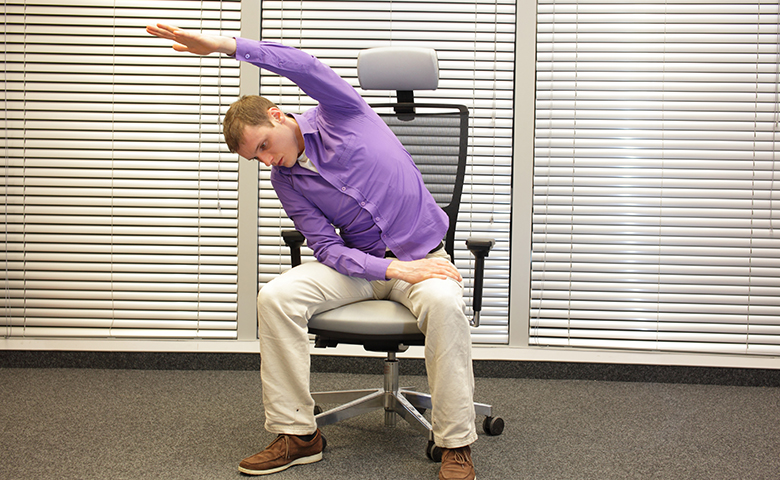
Man performing chair yoga in office chair

For some people, winter is not just cold—it’s downright uncomfortable. Cold temperatures can lead to increased stiffness in muscles, tendons and joints. Because of this, it should be no surprise that winter is generally associated with increased musculoskeletal symptoms. Musculoskeletal pain commonly affects bones, muscles and soft tissue, but connective tissues like ligaments, tendons and fascia are also often affected in musculoskeletal disorders. Whether you work in the cold or you’re only in the cold long enough to get to work, these symptoms can be debilitating. 

The negative impact of musculoskeletal disorders—also known as MSDs—goes beyond bone pain, too. According to the Liberty Mutual Workplace Safety Index, they are the most common workplace injury and cost private sector businesses almost $17 billion annually. So when the winter starts bearing down on your organization, taking steps to mitigate MSDs will help keep your workforce and finances healthy until the weather starts to heat up.

A paper published by the National Library of Medicine indicates that one of the best ways to overcome work-related musculoskeletal disorders (WMSDs) is physical activity. According to the researchers, the key to WMSD prevention is physical exercise, “which seems to reduce low back pain with only 10–15 minutes of adapted exercise performed 3–5 days per week by office workers.”

Of course, in the cold and dark months of a new year, that can be a tall order. It’s tough to stay motivated in the winter when it’s common to feel low in energy or depressed, and that can contribute to lower levels of physical activity. Seasonal affective disorder—most common in January and February—could also play a part in keeping you down. Characterized by sadness, fatigue, a lack of energy, a decreased interest in activities and difficulty concentrating, seasonal affective disorder makes everything more difficult, from work to recreation to MSD-preventing physical activity. Ironically, that same physical activity the disorder prevents is also one of its most effective treatments. Making an effort to stay active can offer a boost of energy, improve your mood and ward off MSDs. That’s why you should add some specific activities catered to these winter challenges in your workplace wellness program—activities like chair yoga.

A recent CNN Health article reported on the benefits of chair yoga, an easy exercise routine that fits well within the suggested 10–15 minutes of exercise three to five days a week to prevent MSDs. Studies have also shown that yoga is an effective treatment for depression, making it the perfect addition to your workplace wellness program and your ergonomic program. Here are a few chair yoga exercises you can share to help those in your facility:

Joint warm-up

The article suggests beginning with a joint warm-up. To do this, sit on the edge of your seat with good posture, keeping your back straight and facing forward. Then make circles with your hands and feet. If you need to concentrate on one at a time, do the hands first and then the feet. This motion can prevent issues such as carpal tunnel syndrome (one of the most common MSDs) in your wrists while also combatting fatigue in the legs.

Side bends

Stretching is a big part of ergonomics and side bends are a good yoga equivalent. Traditional side bends have you stand and bend at the waist, making a c-curve shape in the spine and upper body. A chair yoga side bend has you sitting slightly forward in the chair, with your feet parallel and your knees directly above your ankles. Put your left arm across your body to hold the opposite hip. Inhale, then extend your right hand straight up in the air as far as is comfortable and feel the stretch in your right side. Then exhale and lean to the left, stretching from the right hip to the right hand, feeling the stretch on the whole side of the body. Switch sides and do the same with your left hand up, leaning to the right.

Seated forward bend

In traditional yoga, the forward bend brings the front of the upper torso closer to the lower body and can be done standing or on the mat. The chair yoga movement is similar but done from a seated position. Start facing forward with both feet flat on the floor. Raise both hands in the air, interlace your fingers, then bend forward so your chest is on your knees and your hands touch the floor. Let your head hang heavy.

Twists

A good follow-up to side and forward bends are twists. Traditional yoga twist poses can be done standing, sitting or lying down so long as there’s a rotation of the spine and torso. For a chair yoga twist, sit sideways at the edge of your chair with your left side close to the back of the chair. Check that your feet are parallel and your knees are directly above your ankles. Twist your torso toward the left, holding onto the back of the chair, for a spinal twist. Check that your shoulders have not tensed. Move your legs around to the right side of the chair and repeat the twist to the right side.

Cat-cow

This combination yoga movement of cat pose and cow pose involves arching and rounding the spine. Traditionally performed on your hands and knees, the chair yoga cat-cow mimics the same movements but in a seated position. Starting with cow position, sit facing forward with your hands on your knees or thighs. Inhale and arch your spine, lift your chin and reach your chest forward, bringing your shoulder blades into your back. Exhale and go into cat position, rounding your spine and dropping your chin to your chest, with the shoulders and head coming forward.

Chair yoga is a great initiative to launch in your facility, but it’s not a replacement for regular stretch breaks, which are still required every hour while working. Think of the exercises described here as adding to your existing health and safety habits, fighting off MSDs and breaking down barriers to physical activity. Stretching in combination with chair yoga could be the best solution this winter to prevent injuries and increase workers’ moods. 

On-demand webinar

Using a Human Factors Framework for Safety and Operational Excellence

It can be hard to see the connection between safety, productivity, human factors and organizational systems. This webinar will demonstrate how a human factors framework can impact all areas of an organization, linking individual worker safety and organizational systems and provide an outline that allows leadership to manage safety-focused change.

Watch now

Tagged , , , , , , , , , ,

Construction desk best safety articles of 2024

Every year, thousands of safety articles, blog posts, guides and white papers are published. The collective insight provided in all these pieces of writing is staggering. But not all safety content is the same, and a handful of these safety articles always stand out from the crowd thanks to their relevant insights and inspiring advice.

We’ve gathered some of the best safety articles and guides from 2024. Whether you missed them when they were first published or you want to revisit these articles to refresh your knowledge, you’ll find it well worth your while to read everything in this standout collection of safety writing.

Workplace ergonomics

Last year started off with a firecracker of an article on workplace ergonomics. It’s a relatively short piece, found in the pages of Safety+Health magazine. And what it lacks in length it makes up in insight.

Rather than offer the usual advice on ergonomic safety, author Jaime McKeown offers an overview of why your ergo program might be failing to gain traction. As she says, “Have you heard the adage, ‘You can lead a horse to water, but you can’t make it drink’? When it comes to ergonomics injuries, you can provide the proper training and equipment, but if additional measures aren’t taken by workers, they’ll end up being pretty parched.”

The article points out human factors and safety culture as two key determinants of ergonomic success, and the entire piece functions as a compass to help you reorient your workplace ergo program for more sustainable results.

Construction safety

The ergonomics article opened with a maxim about horses and water, and another interesting safety article—this one about construction safety—might as well have started with this truism about the certainty of change attributed to author John Maxwell: “Change is inevitable. Growth is optional.”

As safety columnist Ray Prest pointed out in the March issue of Occupational Health & Safety magazine, there are a lot of safety lessons to be learned from a construction industry in flux. In particular, Prest notes that the evolving dynamics of the labor market means that safety professionals have a bigger role than ever to play in employee retention and company productivity.

It’s a fascinating and wide-ranging article that introduces three safety interventions to help organizations “ride the fluctuating waves of risk.” And it’s worth your attention even if you don’t work in the construction sector since, as the article says, “these types of interventions are more likely to have staying power in almost any industry.”

Ambiguity and stop-work authority

Sticking with last year’s prevailing theme of uncertainty, the next standout safety article from 2024 is about ambiguity and the effect it has on stop-work authority. Safety consultant Tim Page-Bottorff writes in the Professional Safety Journal that ambiguity is a psychosocial risk that “can directly lead to elevated risk levels in several ways, from skewed perceptions of risk to uncertainty about one’s ability to speak up about concerning work conditions.”

After outlining the specific ways that ambiguity can hamper workers’ willingness to temporarily pause work if they have safety concerns, Page-Bottorff offers some interesting ways to mitigate the effects of ambiguity—not to mention other human factors—when it comes to stop-work authority.

While there are no silver bullets, the article suggests that a small set of soft skills, as well as a focus on relationships and improving confidence while also reducing fear can all reduce the presence of ambiguity. The end result is a more productive workplace and fewer injuries among workers, especially when it comes to new hires.

New-hire safety

Speaking of new-hire safety, a trio of outstanding pieces take a look at the ins and outs of keeping new employees safe in their first weeks and months on the job. And while that seems like a lot of coverage for a single topic, it makes sense when you consider that “a third of all injuries happen to employees who have been at their workplace for less than a year.” That statistic is courtesy of a new-hire safety webinar titled Keeping Workers Safe: The First 90 Days. Presented by safety expert Larry Pearlman, the webinar offers a ton of useful tips and insights into keeping new workers safe, including some quick wins and a compelling look at how to use the first three months of a worker’s tenure to set the stage for a long and productive employer/employee relationship.

Picking up where the webinar left off, a safety article in Occupational Health & Safety magazine argues that the safety stakes are high in new-hire onboarding not only because of the immediate injury risk but because the “new hire onboarding process can also heavily determine people’s view of safety.” As a result, how things go in the first handful of months could affect safety outcomes for years down the road.

And if you want something more comprehensive on the subject of new-hire safety, the new-worker guide Fitting in Fast: Making a Safe Workplace for New Hires has you covered. It provides a detailed look at the issue, beginning by showing that the “new worker” label encompasses several different members of an organization, from young employees to people who have changed jobs to long-tenured folks who have switched roles. Each of these workers faces different risks and safety professionals need to be aware of the distinction between each group.

From there, the guide offers a tour of the key aspects of protecting new hires, providing a road map to long-term efforts to protect one of the workforce’s most vulnerable types of employees.

Hand safety

On the topic of vulnerability, perhaps the most at-risk body part is the hand, based on the fact that hands are among the most frequently injured parts of the body. When you add the fact that every major industry sees droves of serious hand injuries every year, it’s clear that no one’s hands are completely safe in the workplace.

One of the strongest pieces of safety writing from last year was the hand safety guide Insights and Strategies to Prevent Hand Injuries. It’s based on a rigorous survey of hundreds of safety professionals, and the results of that survey highlight some existing best practices and also offer surprising insights into the causes of—and solutions to—hand incidents.

The guide to hand safety is much too detailed to be summarized here. But the data it provides, as well as the five major interventions it suggests will be particularly effective at protecting workers’ hands, make it a critical resource for safety professionals.

Conclusion

Clearly, 2024 was a stellar year for safety writing. From new-worker safety to ergonomics, there is plenty of research, insight and analysis to help safety professionals tackle their thorniest problems.

It’s worth noting that great safety advice isn’t confined to articles and guides—last year saw the release of many informative safety webinars as well. There is one in particular that is must-watch material. It’s a webinar on storytelling in safety called  Unleashing the Power of Stories: Level-up Safety Culture with Three Easy Storytelling Tools, and it does a tremendous job of explaining the necessity of leveraging stories for better safety outcomes and then giving safety folks the tools to do so.

Supported by a set of storytelling resources,  the webinar can provide a useful framework for taking the insights from all of these safety articles and putting them into action in an effective manner. So read the articles and guides, watch the webinar and then get ready to make this the safest year yet!

Guide to Hand Safety

Insights and Strategies to Prevent Hand Injuries

Based on robust survey data, this free guide outlines which safety intervention work—and which gaps are often overlooked in hand safety.

Get the free guide now

Tagged , , , , , , , , , , ,