
Coworkers with stacked hands at the office building culture

Protecting new workers is a tall order, requiring attention to a number of issues. But workplaces that want to successfully mitigate the risk to new hires would be wise to take steps to address three issues: common language, culture, and the concept of human factors

Common language

Hazards and stop-work authority aren’t the only things new hires need to learn about. They also need to be taught the language of the workplace. Otherwise, they may not know how to speak up, and may not be able to understand crucial safety conversations.

Every workplace has its own set of technical terms, slang, acronyms, and other phrases that employees understand and outsiders don’t. Onboarding a new employee isn’t just about teaching them what to do—it’s also about teaching them the vocabulary of the workplace.

When recently hired employees show up at their new job, they bring with them a wide range of assumptions about which hazards are dangerous, what constitutes a safe or unsafe action, and the value of safety protocols. They may even have differing understandings about what basic safety words mean. That’s why it’s so important to teach new hires the common language of safety in your workplace.

As an article in Safety Decisions defines it: “A safety language is a collection of words, terms, and phrases that can be used and understood by everyone to articulate either a potential hazard or a desirable behavior. In short, it’s a common understanding” of what safety words mean and how safety works. It makes sure everyone has the same definition for keywords, phrases and ideas.

It’s easy to overlook the value of a common safety language. After all, surely everyone knows what a “hard hat” is, and everyone surely understands what it means when a supervisor says, “This task is tricky so make sure you take your time.”

The problem is that no, in fact, not everyone knows these things. Most folks know these things, but for the handful of new hires who don’t, using words and phrases they don’t fully understand can create a sense of ambiguity or confusion, and these human factors will compound an already dangerous situation to make it that much riskier.

And you’d be surprised at how many new workers don’t understand, or fully believe in, more advanced concepts like human factors and other safety issues. Taking the time to explain these things to them—and to get their buy-in—will make these new hires safer in the first weeks and months on the job. It will also make it easier to communicate additional safety issues to them, and it will help integrate employees into the company’s safety culture.

Culture

Safety culture is like the air we breathe—when the air quality is fine, you barely notice it. But if it’s polluted, it affects everything you do.

As a white paper on safety culture and climate points out, positive safety culture is linked to improved safety outcomes as well as more consistent, predictable performances across the board. When it’s working, you hardly notice that things are running smoothly. But when cultural issues are causing production processes to grind their gears, it’s all anyone wants to talk about.

You never know how a new hire will affect a company’s safety culture. Will they be a tree that helps purify the air, or will they belch exhaust throughout the workplace? You also don’t know the impact that culture will have on the new employees. Will it reduce their willingness to speak up if they feel unsafe or empower them to look after themselves and their peers? How you integrate new workers into the worksite’s safety culture can dramatically affect the answer to these questions.

A new hire’s first weeks in the workplace can inform their attitudes and interactions with others for years to come. It’s important for frontline leaders—especially a new hire’s immediate supervisor—to convey a certain set of values. Employees who have just joined the company see that safety is a priority when it’s discussed at a toolbox talk. They see it when protective equipment is used whenever it’s required. They see it when safety processes are followed, and when workers who make safety missteps are spoken to in a frank but positive tone rather than being yelled at or blamed. And if these things don’t happen? Then they see that maybe safety isn’t so important in this workplace after all.

You can say what your culture and values are until you’re blue in the face, but new hires will only believe what you show them. So make sure you’re putting your words into action. And don’t overlook the value of consistency. If workers see that safety is important on day one and two, but by day three things get busy and safety is tossed by the wayside, it shows that safety is a nice-to-have and not a primary value. It can take years to undo a first impression like that.

Before onboarding new employees, safety professionals should ask themselves three questions:

  • What values do I want to demonstrate to new workers?
  • How am I going to demonstrate those values?
  • Who else—coworkers, supervisors, the leadership team—can reinforce or undermine those values?

The answers to these questions will help identify where you’d like your safety culture to be heading and who can play a role in getting there. Because providing new hires with a positive and consistent introduction to workplace culture is incredibly important for a number of reasons. Employees regularly cite company culture as a contributing factor to staying or leaving their place of employment, and getting off on the right foot can reduce turnover as well as save lives.

Concept of human factors

Human factors are everywhere, and they’re a clear and constant danger for all employees. They’re also an especially large problem for new hire safety.

Looking out for human factors in the workplace can function in a similar way to hazard recognition. Certain tasks or processes are unavoidably frustrating, or tiring or must be completed with a degree of speed. Experienced workers may recognize that these issues are a built-in part of the job and won’t take the frustration personally. Or they will recognize the need to take a break after a strenuous task. But new workers won’t, and these unexpected human factors can wreak havoc on new hires who aren’t prepared for them.

Workplaces that are serious about safety have likely implemented some sort of human factors mitigation strategies. Maybe supervisors highlight human factors in toolbox talks, or the safety manager mentions them during safety meetings. Ideally, the workplace has also followed best practices and conducted proper human factors training in order to teach workers how to recognize and respond to rushing, fatigue and other factors in real time. (One added benefit to this training: it makes the smaller intervention strategies like toolbox talks much more effective and keeps workers safer 24/7.)

But new workers? They won’t have gone through human factors training. They’ll hear phrases like “rushing” and “mind on task” and won’t understand that these words have very specific meanings. Or they’ll hear a supervisor say, “It’s the end of the week so make sure you pay attention to your level of fatigue,” and they won’t recognize just how important it is to do. And they definitely won’t know how to react if they suddenly notice that they are, in fact, getting tired and clumsy at the end of the day.

One of the most overlooked aspects of new-hire safety is bringing them up to speed on human factors. “Hopefully, you’ll have a human factors training vendor that will be a long-term partner, offering ongoing support for new worker onboarding. In these cases, be sure to talk to your trusted advisors whenever you bring new hires into the workplace. And regardless, there are proactive steps you need to take to bring new hires up to speed.

And if you don’t have outside help to rely on, you’ll need to do it all yourself—so make sure your onboarding plan includes a section on getting new hires to buy into the concept of human factors and then educating them on the human-factor realities of the workplace.

This blog post is an excerpt that has been adapted from the safety guide Fitting in Fast: Making a Safe Workplace for New Hires, which takes a deep dive into new worker safety. It offers strategies to prevent new-hire injuries, offering research and best practices to support a sustainable approach to protecting new workers.


Guide to New Worker Safety

Fitting in Fast: Making a Safe Workplace for New Hires

Protecting new hires is a huge safety challenge. How you introduce them to your company’s culture will dramatically affect their immediate safety and instill shared responsibilities for positive outcomes in the future.

Get the free guide now

Tagged , , , , , , , ,

Safety steering committee in the workplace.

The start of the new year is the perfect time to set things up to run smoothly for the coming months—and that includes your steering committee.

Often formed to implement and sustain specific safety initiatives, steering committees are put in place to guide your company in the right direction when it comes to a new safety offering. But in order to run an effective steering committee, you first need to take a look at the makeup of your committee.

1. Keep it fresh

You typically want people from different departments to make up your steering committee. That way you get different voices, perspectives and knowledge to aid in the steering committee’s functions. At SafeStart, we aim to change who sits on our steering committee annually. Members who have been on the committee for years can become complacent to existing risks, and it’s better to fill your committee with fresh eyes. Having volunteers is often more productive than having voluntolds. If the committee members are there because they want to make a difference, they will approach the meetings and tasks more effectively.

2. Make sure it’s the right size

If there aren’t enough members on your steering committee, it can be viewed as one-sided and people may perceive the committee as not having everyone’s best interests at heart. It’s the same as having a committee comprising only high-level people. Without the voice of a “worker member,” people may not feel like their interests are well represented. By listening to the opinions of all levels of employees, both positive or negative, you’ll gain more commitment from people. But be careful about having a committee that’s too big, as it can be hard to come to a unanimous decision when there are too many members on your committee. If you want to put a number to the committee, six members are often an effective size for a safety steering committee.

3. Ensure you assign different roles to different members

One or more people on the committee can fulfill the roles outlined to fulfill the duties of the committee. Here are six roles that can be used to make up your steering committee:

Chairperson 

The chairperson typically has an authoritative role on the committee. The chair has a clear understanding of the committee’s interests, they ensure all members of the committee are fulfilling their designated roles and they drive accountability for actions that need to be taken next. They lead the committee meetings and guide the committee in tracking progress on action plans.

Training scheduler 

The training scheduler (sometimes referred to as the secretary) organizes safety training and extra-curricular sessions—keeping scheduling and logistics in mind. They are also responsible for attendance tracking and reporting, establishing the steering committee meeting schedule, determining session locations, tracking missed classes and staying on top of post-implementation new hire scheduling. The training scheduler also develops the agenda for the steering committee meetings in consultation with other committee members and distributes it before the steering committee meeting, and takes/distributes steering committee meeting notes/minutes.

On-site administrator 

The on-site administrator often helps the training scheduler with their duties. They also manage the budget and order any required supplies. As part of their role, they may have to prepare invoices and purchase orders, maintain detailed records of inventory and create progress reports where necessary.

Communications coordinator 

The communications coordinator plans and executes communications, and organizes, promotes and implements activities/events to encourage participation and continuous improvement. They are responsible for designing, writing, copy-editing, proofreading, printing and publishing communications products including web and social media content, email communications, marketing collateral, reports, ads, press releases, PSAs, and so on. They often work closely with the on-site administrator when budgets are involved. 

Data coordinator 

The data coordinator is responsible for following up with departments to encourage leading indicator data through activities completed and card submissions, processing cards weekly, reviewing incoming information, collating data in a spreadsheet, identifying themes, and specific opportunities for improvement in processes. They also need to track data provided by implementation committee members—unit completions, communications, leaders’ story videos shared, and other activities.

Member at large 

The member at large has no defined assignment—they conduct various projects, help the committee in a general capacity and accept duties as assigned by the chairperson.

It’s important to define the roles of each committee member clearly. Above all else, communication is the most important aspect of having a successful steering committee—and is not solely the responsibility of the communications coordinator. Communication within the committee is vital to reaching your end goal. 

The entire committee needs to be open and transparent—with each other and the entire company. If there are concerns, they need to be shared. Decisions need to be communicated clearly. The committee should also communicate by listening to the concerns at large. After there’s a plan for resolution, they need to go back and communicate what that is in order to establish trust and boost morale.

Safety steering committees can be challenging to get up and running, especially for organizations that haven’t traditionally used them. But they are a great way to give a new safety initiative an opportunity to succeed.

On-demand webinar

Using a Human Factors Framework for Safety and Operational Excellence

It can be hard to see the connection between safety, productivity, human factors and organizational systems. This webinar will demonstrate how a human factors framework can impact all areas of an organization, linking individual worker safety and organizational systems and provide an outline that allows leadership to manage safety-focused change.

Watch now

Tagged , , , , ,

Digital display in office on resolutions routines and habits

January—the first month of the new year, and a time to reflect on the lessons of the past year. A time to set things anew and create resolutions to do something differently to achieve better outcomes personally or in the workplace.

According to folklore, the weather of the first twelve days of the year indicates how the following twelve months will go. The same can be true for your habits. With the right mindset, if you have a good first twelve days of the year working on new habits, you can set yourself up for a successful year. 

Good habits are tough to form, and bad ones are hard to break—that’s why you shouldn’t do it alone. According to our How to Make Habits Stick guide:

“The best way to ensure that you stick to what you set out to do is to involve someone else. If you share your goals with others, they will keep you accountable—which is vital to sticking to a routine and achieving your goals. Having to tell someone you failed is more distressing than missing a day and quietly resuming your activities the next day. That’s why it’s good to have a buddy at the gym. They will push you to go that little bit further where, if you were by yourself, you’d stop when it got too hard.”

But in order to get everyone on the same page, this message must be communicated. Why not create a digital display presentation on the topic of creating new habits/resolutions for the new year?

Start with a statistic to get their attention:

Did you know that fewer than 10% of people actually achieve their goals when trying to create new habits?

Your next point should illustrate the fact that this problem is solvable, as long as people understand the difference between a routine and a habit. Define these in your presentation:

•  A routine is an everyday task, chore, or duty that you do at a particular time
•  A habit is something that you do regularly, often subconsciously

Skipping a routine doesn’t feel as bad or uncomfortable as not performing a habit. People can often justify not eating lunch at noon one day (routine) but not putting on their seatbelt before driving (habit) feels unnatural.

If you want to change a habit then you first need to look at the routine associated with that habit. Smoking cigarettes is a hard habit to break because people associate smoking with a lot of routines (e.g., having a cigarette with a coffee in the morning, having a cigarette after eating a big dinner, having a cigarette while driving to and from work, and so on). In order to break the habit, something in the routine needs to change first.

In safety, when people become complacent to risks, their habits automatically kick in (regardless of whether those habits have a positive or negative impact on safety). Communicating this in your digital display presentation can help people succeed while maintaining their new habits. 

Additionally, creating a habit and telling other people helps develop a sense of accountability. Communicating this in your digital display presentation or in a safety meeting will get people talking about it at your worksite and spark them to push each other to succeed. Here are some points you should include:

1. Make a schedule

Whether your group is trying to use existing routines to incorporate new habits or creating a new routine to stay on track with habit-building, they must set a schedule to stay on task. Consciously planning the time spent on specific tasks increases efficiency. When creating a schedule to work on habits, it’s important to start small—a manageable task in small chunks of time doesn’t take away from things already planned in an existing schedule, only takes a small amount of time to complete, and therefore feels more achievable.

Another benefit to scheduling time to work on habits is that people can coordinate their schedules with others to work on habits together. Doing a new activity in a group is a way to make people less nervous, ensures they show up and allows the group to hold each other accountable in their new endeavor (lunchtime walks or workouts are a popular workplace habit that people do together).

2. Prioritize tasks

It’s important that people know the time scheduled to work on habits has to be non-negotiable in order to be successful. Things are always going to come up that cause people not to want to put in the work when trying to form new habits. When it comes to human factors, you can’t always predict what’s going to happen. Things beyond our control will inevitably happen. But you can control how you react to these situations. Encourage people not to become discouraged if their schedule has to be altered slightly. The important part is not giving up. In your digital display presentation, suggest using scheduling tools to keep them on task with their habit formation.

3. Pay attention to the human factors

One thing that is vitally important when working on habits is to self-trigger on any human factors that may be experienced. As previously noted, scheduling and prioritizing tasks is important—but when a new habit is thrown into an existing schedule, it’s not uncommon for rushing, frustration or even fatigue to influence habit-building during the formative stages. Your digital display presentation should reiterate that self-triggering when people are in one of these states can prevent an incident from occurring and help the habit-building from derailing. If others are practicing the same habit you are, tell a story about how your state of mind impacted you working on your habit. This will not only hold you accountable for developing your habit but it could even prompt a meaningful conversation.

By integrating these strategies into your digital display presentation, you can effectively start the conversation about people collectively working on habits in your facility. Establish accountability by sharing your own goals with your team—this will help to keep you on task and ensure you continue to perform them daily, and it could make it easier for your team to build their own habits too.

Free guide

How To Make Habits Stick

Most of what we do every day is habitual, so learning how to change or form new habits can be a game-changer in safety. Use this guide to help your employees learn how to do it effectively.

Get the free guide now

Tagged , , , , , , , , ,

Yoga and meditation in the office.

Exercise is part of a healthy lifestyle and has far-reaching benefits. Physical activity prevents health problems and reduces the risk of developing long-term medical conditions, helping people live longer and richer lives. It aids in sleep, boosts energy, improves mental well-being and reduces stress. At work, exercise increases safety, reduces absenteeism and improves mental health, leading to more engaged employees with better job satisfaction. But despite all these benefits, very few people meaningfully engage in fitness.

According to a study published by the Center for Disease Control, less than one-third of U.S. adults meet suggested benchmarks for aerobic and muscle-building activities. And that leaves us with a big question:

Given all its clear benefits, why do people struggle so much to exercise?

The biggest barrier to physical activity for most people is psychological, which is ironic when you consider the many improvements exercise brings to one’s mental state. The same human factors that have serious impacts on the critical errors we make also get in the way of improving our ability to manage them. It’s a vicious cycle that can affect both health and safety.

Learning to recognize and manage your mental states can keep you safe and help you hurdle barriers to exercise in a big way. But there’s more you can do. In addition to human factors training, you can also give your brain a workout to keep you mentally sharp and strengthen your mind, helping you overcome future challenges, like getting motivated for physical activity. Introduce these three exercises to everyone in your facility to help pump up their brainpower.

1. Mindfulness meditation

Mindfulness meditation is a habit you can work on to train your mind to focus and redirect your thoughts. When done regularly, meditation has been proven to reduce stress and help people control their reactions to the world around them. Arguably the best exercise for your mind, this activity can significantly reduce stress and improve your ability to manage human factors like frustration and rushing.

To implement mindfulness meditation in your workplace, follow these tips:

  • Set a schedule to prioritize your meditation. A daily routine is best, and shorter sessions with a limit of 10 minutes are most effective in the workplace.
  • If a group setting provides the accountability required to add meditation to your calendar, set up a recurring date, time and place in your facility for the meditation.
  • Meditation can also be done alone—all you need is a quiet comfortable space to focus.
  • Choose a quiet spot that is free of distractions—some people like to play calming music to help maintain focus, especially if there is minor outside noise.
  • The purpose of meditation is to channel your focus. Focus on your breathing. Focus on your comfort. You can sit cross-legged on the floor or perform the meditation in chairs, so long as they are comfortable and quiet for the duration of the session.
  • Guided meditation recordings can be very helpful in maintaining focus for a full session, especially if you or your companions are new to this effective exercise for your brain.
2. Play Solitaire

Remember when Solitaire was the only game installed on your computer? Playing card games at work might seem taboo, but studies have shown that a quick card game can improve cognitive functions like memory and thinking skills. A card game could be just the thing to ease your mind and train your focus. Solitaire, for example, requires memorization, recognizing patterns, planning, concentration and the use of reason.

Since it’s a game you play by yourself, Solitaire offers a similar stillness to meditation as you focus your concentration on the cards. And you don’t even need a physical card deck for this exercise. You now have access to several free games on your phone, Solitaire included. So regardless of where you work, you can exercise your brain on your breaks. And don’t worry if Solitaire isn’t your thing, there are plenty of games and apps you can download that have similar effects.

3. Get wordy!

Card games aren’t the only fun way to stay sharp. According to Dr. Elana Clar, MD, a neurologist with New Jersey Brain and Spine, word games are good exercise for your mind, too. But if you’re not into words, there are other options that can be just as effective. “Word games like crossword puzzles and Scrabble are great, but numeracy puzzles like sudoku and chess are also fantastic for supporting memory,” Dr. Clar says.

Just like card games on your phone, word and number games that provide intellectual stimulation are something you can do anywhere. Buy a puzzle book or download a Scrabble, sudoku, or chess app to play on your break. You could even download a free second-language program to stimulate your brain and improve your communication skills at the same time.

There are a lot of ways that you can exercise your cognition, and these three suggestions are easy ways to get started while you’re at work. Try creating a new habit of exercising your brain every day. To set you up for success, let’s recap the do’s and don’ts from our How to Make Habits Stick guide:

Don’t put off starting … Do start small

You cannot create a habit overnight, but you have to start the process of creating a habit somewhere. And the best way to do that is to start small. Use your language app a few days a week, for a short amount of time (maybe start with five minutes) and work your way up from there.

Don’t give up … Do make it easy

Creating a new habit can be a challenge of its own, but you have to stick with it. Make it easy by preparing ahead of time. Schedule your new habit and make it a priority. By putting a block of time in your calendar to play Solitaire, you’re ensuring that you don’t schedule anything else at the time that will get in the way of you exercising your brain.

Don’t keep it to yourself … Do focus on the reward

If you decide you want to start meditating, recruit a group of people to do it with you. Creating a habit with other people helps you stay accountable. In your group, you should also talk about how your meditation routine is making you feel. By focusing on the rewards of meditation, you’ll reinforce the positive results you and your group are experiencing, making it feel all the more worthwhile for everyone involved.

Keep at it and soon you’ll be reaping the benefits of a healthier mind. Exercising your brain will not only help you overcome the mental challenges that stand in the way of exercising your body but it will also help you manage fatigue and other human factors like complacency, rushing and frustration, which can all lead to injuries—staying mindful means staying safe.

Free guide

How To Make Habits Stick

Most of what we do every day is habitual, so learning how to change or form new habits can be a game-changer in safety. Use this guide to help your employees learn how to do it effectively.

Get the free guide now

Tagged , , , , ,

Group of young workers standing confident in work place.

The facts are clear: new hires are at a much greater risk of injury in their first year on the job. But not all new workers face the same risks. Depending on their age, background, work history, and other issues, they may face very different dangers in the workplace.

This is an outline of four classes of new workers, and some of the risks that can be particularly challenging to them. As new hires are onboarded, be sure to pay attention to these potential sources of injury in order to keep these at-risk groups of employees safe.

Young workers

Young workers are physiologically different from the rest of the workforce in ways that can put them at risk. Their organs and musculoskeletal systems are not yet fully developed, making them more susceptible to harm from certain types of trauma and hazardous substances. Additionally, as NIOSH points out, “young workers may be exposed to suspected asthma-causing agents and substances that disrupt the function or maturation of the endocrine and central nervous systems.”

Young workers also get a bad rap for being distractible. It’s trendy to blame cellphones and distraction for the high rate of incidents, but several studies suggest that injury rates among young workers are not a new trend or a result of technological distraction. A study conducted by the CDC looked at injury rates of young workers from 1998–2007, before the first iPhone was released. It found that the nonfatal injury rate “was approximately two times higher” than older workers. This is still the case, as a recent article in ISHN notes that the current generation of 18–24-year-olds is experiencing a similar rate. Instead of blaming technological influences for distraction, we should look at other human factors that are likely to influence young workers, like overconfidence, ambiguity, and rushing. And when you combine these human factors with a general lack of experience, it leads to the grim emergency-room data that shows that young workers are injured twice as often as their older counterparts.

It’s also worth noting that many people believe that young workers are more likely to bounce back quickly from an injury and they are more likely to avoid an injury in the first place thanks to quick reflexes. But their youth can also be a disadvantage as, from a utilitarian point of view, a young worker who receives a life-long injury, such as a herniated disc or compressed nerves in the spine, will be affected for many more years than an older worker who suffers the same outcome. And this high degree of confidence in young workers’ physical resilience can skew their perspective of risk in life-altering ways.

New to country, language or culture

A person who has just secured a job in a new country will, by definition, be a new worker. In 2021, foreign-born worker deaths in the United States were led by Hispanics, whose working population grew 16.7% and for whom workplace fatalities grew 42%. Similarly, non-Hispanic Asian workers saw a 40.2% leap in workplace fatalities and a 30.8% growth in the working population.

 In both cases, as these working populations added more new workers, the number of fatalities grew even more rapidly. This is not a coincidence. We’ve already seen that new workers are at much greater risk of injury, and foreign-born workers have to contend with a tremendous amount of change all at once.

Additionally, depending on their circumstances, there could be many reasons why foreign-born workers feel unable to say no to unsafe working conditions or ask questions if the instructions for the task at hand are ambiguous.

One does not have to be an immigrant in order to encounter these challenges. A workplace may operate in a language or dialect that a domestic-born worker is unfamiliar with, rely heavily on slang or technical jargon, or be situated in an unfamiliar regional culture. A move from one city or state to the next may be enough for someone to encounter all these problems.

Older workers

Older workers tend to be more experienced workers. But experience at previous jobs doesn’t necessarily translate to the new employer, and the length of time at their current job is a much stronger factor in injury risk than the number of total years they’ve spent in the workforce.

Experience can also be a double-edged sword. As safety consultant Larry Pearlman points out, older workers can often misjudge their own abilities. Pearlman says that when encountering potentially dangerous situations in the workplace, older workers can think, “When have I seen something like this before? and rely on their past experience and performance in similar situations. The trouble is that they sometimes fail to recognize that hazards, safety protocols, and technology have changed. Their ability to accurately assess and react to the situation may also have changed with age. All of which increases the risk of injury when older workers switch employers.

There’s also run-of-the-mill complacency, which can set in when someone feels like they have ample experience with a certain context or task—even if the specific job is new to them. And job-specific inexperience and general complacency can be a dangerous mix. These factors all contribute to the fact that older workers who are new to a job are at such great risk of injury.

New situations for experienced workers

Change is change, period. And with enough workplace change, any worker becomes a new worker. Usually, the biggest change that can happen to a worker is when they get a new job. But sometimes an employee can show up to the same worksite as always and find that the specific environment, workflow or tasks they need to do have shifted to such a great degree that a long-tenured worker suddenly becomes “new. When a new mechanical or digital process is introduced, when new regulations need to be followed, or when high employee turnover creates a new social dynamic, workers of all experience levels are subject to the same human factors we commonly see in new hires. This also applies to temporary workers who may have general experience but lack knowledge of specific tasks and the work environment.

This advice is meant to be broadly applicable. That means it can’t always cover the nuances of every single type of new worker. Be sure to consider the specific type of new worker that is present in your workforce and adjust your takeaways accordingly.

This blog post is an adapted excerpt from the safety guide Fitting in Fast: Making a Safe Workplace for New Hires, which examines data and best practices regarding the protection of new hires in the workplace. Read the guide today for research, insights and strategies to protect new workers from injury.

Guide to New Worker Safety

Fitting in Fast: Making a Safe Workplace for New Hires

Protecting new hires is a huge safety challenge. How you introduce them to your company’s culture will dramatically affect their immediate safety and instill shared responsibilities for positive outcomes in the future.

Get the free guide now

Tagged , , , , ,

Decorating for Christmas

December is an exciting time of year, jam-packed with festive activities. The approach of winter holidays has us decorating, shopping, baking, hosting parties, exchanging gifts and everything else that comes with making the season merry. But along with the fun comes a dangerous element: the influence of human factors, which often results in injuries.

When human factors are at play, the risk posed by other hazards skyrockets, and in the holiday season that means they contribute to slips, trips and falls (STF). Nothing ruins a time of celebration like an STF injury. That’s why, this December, it’s a good idea to design a digital display presentation around human factors and slips, trips and falls. It will help bring holiday states of mind into focus and keep employees at your facility safe, both on and off the job.

Safety is an excellent gift, because nothing spoils a party like a trip to the emergency room. An effective digital display presentation on this topic—which includes the human factors that most people experience during the holidays and how they impact the existing seasonal hazard of slips, trips and falls—can mean the difference between having a happy holiday or a dismal new year.

Rushing to the ground

With all the additional things on your to-do list (and not enough time to do them), the holiday season could justifiably be called the rushing season. In December, people often find themselves rushing to finish a lot of the tasks associated with the holidays, and that’s when they are extra vulnerable to STF hazards. Include an attention-grabbing stat in your digital display presentation to demonstrate how big of a problem holiday slips, trips and falls are. According to the Consumer Product Safety Commission (CPSC)…

There are an average of 200 decorating-related injuries per day during the holiday season, most of which are falls.

The rushing nature of holiday task completion can impact how people see things—or fail to see things. Rushing can influence folks to take shortcuts and ultimately leave them vulnerable to slip, trip and fall incidents. Illustrate the dangers of rushing with relatable holiday examples. For instance, any time you rush in the kitchen, bad things can happen. A rushed cook could spill something on the floor, fail to clean as they go or not use an appropriate step ladder to reach things—three surefire contributors to slips, trips and falls. 

Another relatable example is if you’re outside putting up decorations or bringing in your groceries from the car. Slip, trip and fall hazards can be increased by the winter weather that accompanies the holiday season. An icy driveway or slick rooftop is dangerous on its own, but add in the human factor of rushing and the potential of getting hurt increases.

Be sure to include a tip in your digital display presentation to help people head off the effects of holiday hurrying. Predicting when rushing will happen can help you plan ahead to prevent a slip, trip and fall incident. Take note of when your to-do list is getting long and remind yourself to take extra time for safety. When it comes to rushing, it’s important to slow down and plan your tasks ahead of time.

The downward spiral of holiday frustration

Frustration strikes when things don’t go as you intended them to. This familiar feeling can be amplified around the holidays with so many activities and so much planning outside of your normal schedule. It’s natural to get angry or stressed out when your plans don’t go off without a hitch. But if you’re seeing red, you might not see the slip, trip and fall hazards that are right in front of you.

Here’s another eye-catching stat you can use in your digital display presentation to demonstrate how common frustration is during the holidays:

Nearly nine out of 10 people say that concerns such as not having enough money, missing loved ones and anticipating family conflict cause them stress at this time of year.

That frustrated feeling of ineffectiveness or lack of capacity to change the situation can be distracting to the point where you’re not able to think while performing mundane tasks. Unsurprisingly, the distracted mind will miss the most obvious dangers, leading to slip, trip or fall incidents. And those incidents can lead to even more frustration, contributing to a vicious cycle of human factors, risk and error. In order to overcome frustration you need to change the perception of risk. Common techniques for changing risk perception, gathered from our Solving slips, trips and falls once and for all guide, include:

  • Play videos or share stories that show the impact of slips, trips and falls
  •  Provide stats about the dangers and potential severity of slips, trips and falls (you could share some of the ones from this guide)
  •  Ask how much an injury would limit them at work, at home with their family, and in sports and hobbies

Add these techniques to your digital display presentation to equip your audience with the tools to reframe risk and save them from spiraling into holiday frustration, which can lead to injury.

Drunk-tired for the holidays

It should be no surprise that people find themselves more tired during the holiday season. From preparing for gatherings to fitting them into a set number of days, many people wake earlier and go to bed later for the entire holiday season—which means they’re incurring sleep debt and putting themselves at higher risk of injury.

But they’re not just sleepy. Use a statistic like this in your digital display presentation to inform people that fatigue is comparable to alcohol when it comes to acting impaired:

20 hours without sleep is equivalent to a blood-alcohol concentration of 0.08%—the legal limit

Your digital display presentation should point out that because fatigue impacts everyday actions, slower reaction times and decreased alertness can lead to a slip, trip or fall incident. Fatigue will also impact judgment. So when you’re tired and use a nearby (perhaps not the most stable) chair to put up decorations or reach for stored-away dishes instead of going to get a step ladder, fatigue is fueling your urge to take the shortcut and setting you up for a fall.  

Exhaustion is a tough human factor to tamp down, but we have you covered. SafeStart has a lot of great resources on what to do about fatigue, use them to help your workforce by including excerpts in your presentation. A great place to start is our blog post about how you can curb fatigue with some healthy snacking habits—a great reminder in this season of sweets, feasts and alcoholic drinks.

Unwrapping habits for a happy new year

The last fatigue example—using an unstable chair instead of a stepladder—is also a great setup to explain how complacency contributes to the risk of slips, trips and falls. If you’ve been using the nearby chair regularly, and nothing bad happened because of it, you’re likely going to disregard the risks of falling in favor of how easy it is to just use the chair instead of going to get a ladder or step stool. But the risk is still very real and preventable.

The same is true for new decorations or other slip, trip and fall hazards—the longer the hazard is there, the less likely you are to notice it. If you plug in your Christmas lights with an extension cord, you’re aware of the hazard the cord presents when you first put up the lights. The longer you’re around them without incident, the more complacent you become to the original hazard of the cord until you trip on it. Use an example like this in your digital display presentation to clearly spell out how holiday complacency can impact slips, trips and falls.

One way to fight complacency is to work on your habits. With New Year’s resolutions fast approaching, it’s not a bad idea to get people thinking about them now. Our guide How to Make Habits Stick can help. Use the information in this guide for your digital display presentation, print out copies or provide a link to the guide so everyone can work on their habits for an injury-free holiday.

On-demand webinar

Dead Tired: What Every Company Must Know About Fatigue

Fatigue is one of the most significant issues that companies face in every industry, as it affects safety, quality and productivity. Workers aren’t just tired—they’re dangerously impaired. This presentation will help you develop a plan to manage fatigue both corporately and individually.

Watch now

Tagged , , , , , , , , , ,

Winter Storm Warning Sign With Snowfall and Stormy Background

White blankets of snow, shimmering frost and crystal icicles hanging from the trees paint the most beautiful pictures of winter. But the weather outside can be frightful for those who must step outside and navigate the hazards of winter. Over 70 percent of the roads in the U.S. are located in wintery regions that accumulate more than five inches of snow on average annually, and that spells danger when the temperature starts to drop.

Whether you’re used to dealing with a lot of snow and ice or you’re experiencing frigid weather for the first time, every winter season finds people unsure of how to react to the hazardous conditions that come with it. From understanding how to dress for certain weather events (hypothermia can happen in temperatures as high as 50°F ), knowing what temperatures will create black ice on the road even though it looks clear while driving, and being able to tell when to salt walkways to prevent slip, trip and fall incidents—staying safe is a complicated proposition as winter wreaks havoc. And everyone can use a reminder about some winter safety best practices.

Before we get into snowy specifics, we need to make sure we’re all speaking the same common language. A few key definitions are important when it comes to understanding the far-reaching impacts of winter weather.

Black ice – a clear film of ice on a dark surface (like a road, parking lot or paved driveway) that is difficult to see.

Blizzard – a severe snowstorm with high winds and low visibility.

Freezing rain – rain that freezes on impact with the ground or solid objects, creating icy surfaces.

Frostbite – the most common freezing injury caused by exposure of the skin and underlying tissues to extreme cold, usually on the hands and feet.

Hypothermia – a condition that occurs when more heat is lost than a person’s body can generate and their core body temperature drops dangerously below 95°F. As a person develops hypothermia, they slowly lose the ability to think and move.

Sleet – a form of precipitation consisting of ice pellets, often mixed with rain or snow.

Whiteout – a weather phenomenon when blowing snow severely limits visibility. Whiteouts may create scenarios where snow completely blocks a driver’s view of the road.

Watches, advisories and warnings

As with other severe weather like thunderstorms and hurricanes, readiness is crucial to staying safe in winter storms. Thankfully, your local National Weather Service office can predict when severe winter weather will strike, issuing watches, advisories and warnings so that the public can be prepared. But do you know the difference between a watch, advisory or warning when it comes to winter storms?

Winter Storm Watches are issued at least 24 hours in advance of a storm to allow people enough lead time to make plans to stay safe. A watch indicates the risk of hazardous winter weather manifesting has increased to 50% or greater, but its actual occurrence, location and timing are still uncertain. Reflecting the wide variety of winter storm weather, watches can vary depending on what weather is forecast.  A Blizzard Watch, for instance, will be issued for an expected blizzard event with less than ¼ mile visibility due to falling or blowing snow, and winds of at least 35 mph.

As the weather event becomes imminent, once it has over an 80%  chance of occurring, a watch will normally be upgraded to either an advisory or a warning.

Winter Weather Advisories are issued for conditions that are not hazardous enough to meet warning criteria but still pose a significant inconvenience and, if caution is not exercised, could lead to situations that may threaten life or property. These include snowfall of three to five inches in 12 hours, sleet accumulation up to ½ inch, freezing rain in combination with sleet and/or snow or blowing snow. Separate advisories may be issued for a specific element like a Freezing Rain Advisory, which is issued when ice accumulation is expected up to ¼ inch.

A Winter Storm Warning indicates that conditions will pose a threat to life or property and that travel will become difficult. A winter storm warning includes heavy snow of at least six inches in 12 hours or at least eight inches in 24 hours. It can also be issued if sleet accumulation will be at least ½ inch. Separate warnings may be issued for specific elements like an Ice Storm Warning, indicating that ice accumulation of at least ¼ inch is expected, or a Blizzard Warning, indicating that blizzard conditions are expected to continue for at least three hours.

Severe winter storm preparation tips

If there’s ever a time that it’s vital to be prepared before a storm hits, it’s the winter. Understanding human factors can play a big role in ensuring you’re ready to face the ice-cold dangers of the season. Complacency or forgetting the severity of winter weather risks can cause serious injuries and fatalities. Fatigue can creep up on you in the winter if you unexpectedly have to shovel or walk in deep snow, and frustration can also come on pretty quickly if you’re not expecting traffic delays due to seasonal road conditions or their resulting accidents. All of these scenarios can cause delays that lead to rushing, another human factor that is exponentially worse in winter conditions. Given this seasonal flurry of human factors, being prepared is the best way to manage risk in the coldest months of the year.

It’s a good idea to make winter prep a habit in the event that bad weather arises because even with watches, advisories and warnings issued by the National Weather Service, you want to avoid rushing to get everything you need before a storm arrives and conditions start to deteriorate. Often, the primary concerns in a winter storm are the potential loss of heat, power, cellular service and a shortage of supplies if storm conditions continue for more than a day. For specific situations, here are some reliable preparation tips that can help keep you safe 24/7 in winter.

What to do before winter weather strikes
  1. Put together an emergency kit that includes things like a three-day supply of water, food that won’t spoil, a first-aid kit, prescription medicines, a battery-powered or wind-up portable radio, a flashlight, extra batteries, an extra set of car keys and cash.
  2. It’s important to have a similar emergency kit stored in your vehicle. Make sure the vehicle kit has winter-specific items like blankets and sleeping bags, one change of clothing and footwear per person, a sack of sand or cat litter for traction, a shovel, a candle and matches to provide light and lifesaving heat in an emergency. Also include jumper cables, a flashlight, bottled water and non-perishable snacks.
  3. Keep a full tank of gas.
  4. Have extra batteries for radios and flashlights.
  5. Practice your emergency evacuation plan (at home and at work)—ensure everyone knows the designated meeting place, important phone numbers and safety rules.
  6. Install and test smoke alarms and carbon monoxide detectors with battery backups.
  7. Winterize all your vehicles before the season is in full swing.
  8. Prepare your home to keep out the cold with insulation, caulking and weather stripping.
What to do at work
  1. Follow the instructions of the personnel in charge of your workplace’s emergency plan.
  2. Locate an emergency kit in the event of a power outage and need to stay in the building.
  3. If the weather is bad enough that the facility must close, it’s the responsibility of the employer to notify all employees of the closure.
  4. Make sure the office building is safe—clear sidewalks and parking lots of snow and ice, and use salt on areas where people walk.
  5. Make sure there is heat in certain areas of the building, and cordon off the areas where there isn’t any heat.
  6. Generators should always be used outdoors and at least 20 feet away from windows and doors.
  7. Listen to radio updates on weather conditions.
  8. If possible, prepare employees to work at home when necessary.
What to do at home
  1. Follow your home emergency plan.
  2. Listen to radio updates on weather conditions.
  3. When using alternative heat from a wood stove or space heater, make sure you properly ventilate—carbon monoxide is a silent killer in the winter.
  4. Generators should always be used outdoors and at least 20 feet away from windows, doors and attached garages.
  5. If heat is not available, close off unneeded rooms, seal the bottoms of doors with towels and try to contain heat in certain areas.
  6. Make sure to eat and drink. Food provides the body with energy for producing its own heat. Keep your body replenished with water to prevent dehydration.
  7. Wear layers of loose-fitting, lightweight, warm clothing. Remove layers to avoid overheating, perspiration and subsequent chill—perspiration can lead to frostbite and hypothermia in cold temperatures.
What to do if you’re outside
  1. If possible, seek shelter and try to stay dry.
  2. If you are not near a vehicle or a building of any kind, turn to nature for shelter from the wind. Check to see if the area has any trees and brush. If there’s thick enough tree coverage, build a shelter out of branches. If building a shelter in the trees is not possible, dig a snow fort or snow cave. Deep snow is a great insulator.
  3. Build a fire to not only create heat but also draw attention to where you are located. Place rocks around the fire to absorb and reflect heat.
  4. Make sure to eat and drink. Food provides the body with energy for producing its own heat. Keep the body replenished with water to prevent dehydration. Do not eat snow—it will lower your body temperature.
  5. Wear layers of loose-fitting, lightweight, warm clothing. Remove layers to avoid overheating, perspiration, and subsequent chill—perspiration can lead to frostbite and hypothermia in cold temperatures.
What to do if you’re in your vehicle
  1. If driving in white-out conditions, it is recommended to navigate your vehicle to a safe place to stop—a parking lot or an area where your vehicle will be seen, away from traveled portions of the road to avoid chain-reaction collisions. It can be easy to become disoriented in wind-driven snow.
  2. Check to see if you have cell reception and let someone know where you are.
  3. Make sure the vehicle’s exhaust pipe is not blocked.
  4. Turn the vehicle on for ten minutes every hour or so to run the heat. If this is no longer possible, use the candle and can from your emergency kit as a source of heat inside the vehicle.
  5. Stay inside the vehicle until the severe weather subsides. Watch for signs of frostbite and hypothermia. Red and painful skin can be a sign of frostbite. Change into dry clothes and shoes from the emergency kit while remaining inside the vehicle under a dry blanket.
  6. Vigorously move arms, legs, fingers, and toes to keep blood circulating and to keep warm.
  7. Make sure to eat and drink. Food provides the body with energy for producing its own heat. Keep the body replenished with water to prevent dehydration. Do not eat snow—it is mostly made of air and melting it in your mouth exhausts your body’s energy.
  8. Wear layers of loose-fitting, lightweight, warm clothing. Remove layers to avoid overheating, perspiration, and subsequent chill—perspiration can lead to frostbite and hypothermia in cold temperatures.

Now that you’re prepared for the next severe winter weather activity in your vicinity, spread the word to help build the winter preparation habit in your workplace. Print the guidelines in this post, use them in your digital display presentations or incorporate them into a toolbox talk to ensure that your employees are safe in the event of severe winter weather.

On-demand webinar

Improving Culture, Safety and Performance with a 24/7 Approach

80% of injuries happen off the job but most workplace safety programs only apply during work hours. In this webinar, you will learn how a 24/7 approach can increase employee engagement during safety training, improve your safety culture, and positively impact your bottom line.

Watch now

Tagged , , , , , , , , , , , , , , ,

SafeStart team at awards gala

SafeStart is the 2024 winner of the Best Safety Industry Provider award category of Canada’s Safest Employers Awards. The other nominees in the category—4S Consulting Services Inc., EKT 90 Inc., HSE Elements, Journey to Zero Safety Solutions Inc., National Safety Services and Safety First Consulting Professional Corporation—were stiff competition as they all do such vital work. 

At the Canadian Occupational Safety Gala in Toronto, SafeStart’s CCO Don Wilson gave an acceptance speech that really drives home the company’s mission of 24/7 safety. SafeStart tracks its success by the number of lives saved as a result of its training, but Wilson noted that having the hardware to back up its work feels pretty great.

Don Wilson acceptance speech

After the awards were handed out, SafeStart’s CEO Barb Tait told Canadian Occupational Safety “Winning this is a tremendous honor, especially alongside peers who are equally passionate about protecting people. Our clients return because we go above and beyond, and we’ve maintained this standard for over 25 years.”

SafeStart also sponsored an award at the event. The SafeStart Award for Canada’s Safest Employer for Young Workers recognizes an organization in any industry that has innovated ways to put unique practices in place to engage, train and mentor young workers while also displaying exemplary health and safety practices specifically targeted to workers under the age of 25. Over a third of nonfatal workplace injuries happen to workers who have been with their employer for less than 12 months.

“SafeStart is proud to sponsor Canada’s Safest Employer for Young Workers Award,” said Tait. “Protecting young workers is one of the most important—and challenging—tasks for safety professionals. We’re thrilled to recognize and celebrate organizations that go above and beyond to safeguard this vulnerable group of employees.”

The City of Barrie won the SafeStart sponsored award, standing out in a category filled with many other remarkable finalists who demonstrated excellence in protecting young workers. This includes the City of Surrey, Flomax Compression, Green Infrastructure Partners, Kawartha Dairy Ltd., Modern Niagara, Pronghorn Controls, Rabcon Contractors Ltd. and SAT Consulting & Construction.

Canadian Occupational Safety notes that the combination of SafeStart’s sponsorship and award win “emphasizes a broader commitment to safety across various sectors. With leaders like SafeStart and exemplary recipients such as the City of Barrie, Canada’s workplace safety standards are not just being met—they’re being redefined for future generations.”

The mention of future generations is apt, with the incoming cohort of workers facing steep safety challenges as they enter the workforce. Fortunately, a new guide on young worker safety offers crucial tactics to bring people up to speed on safety before they get hurt on the job. Developed by SafeStart as part of the company’s commitment to protecting young workers as much as their more experienced colleagues, the guide is called Fitting in Fast: Making a Safe Workplace for New Hires and is free to download and share within your facility. 


Guide to New Worker Safety

Fitting in Fast: Making a Safe Workplace for New Hires

Protecting new hires is a huge safety challenge. How you introduce them to your company’s culture will dramatically affect their immediate safety and instill shared responsibilities for positive outcomes in the future.

Get the free guide now

Tagged , , , , , , , , ,

New and young workers in manufacturing industry receiving onboarding

No one is ever completely free of injury risk in the workplace. But some workers are at a greater risk of harm than others. More than any other group of employees, new workers—that is, people who have been at their current workplace for less than a year—have an outsized chance of being injured.

A new guide on the subject collects recent research on new worker safety and presents a compelling case for the dangers to recent hires. According to Fitting In Fast: Making a Safe Workspace for New Hires, new workers and young workers are both at major risk of being hurt or killed on the job:

No matter where you look, the story is the same: new workers and young workers face a significant chance of being hurt at their place of employment. But as the guide points out, not all new workers are the same. In fact, there are many notable differences from one group of new workers to another.

Knowing your new workers

Young workers are perhaps the most easily recognized of the various types of new workers, likely because their age makes them, by definition, new to the workforce. But there are still several myths about the resiliency of young workers. The new safety guide dispels these misconceptions while also outlining several overlooked ways that the fresh faces in a workforce are at risk of injury.

Other types of new workers include laborers who have changed companies, people who have moved from one city to another and folks who may have found employment in a region that speaks a different language or has an unfamiliar culture. Each of these instances results in an employee ending up with an unfamiliar employer and, often, having a harder time fitting in than one might expect. It’s well understood that safety culture plays a huge role in injury outcomes and so it makes sense that a change in workplace culture can leave new hires more vulnerable.

As the guide points out, experienced workers who have switched roles or tasks may also be considered new workers. This may not be obvious on the surface, but the “core issue is a lack of experience at a worksite. As one report concludes, ‘the key risk factor is newness, not youth.’” An extensive work history may not matter if the specific job function is new to someone.

For all these differences, new workers have a few things in common. Fitting In Fast: Making a Safe Workspace for New Hires outlines how hazard recognition, stop-work authority and what it calls “the three C’s” all contribute to elevating the risk of incidents involving employees who have recently joined the workplace. It’s a clear-eyed breakdown of issues that are well worth reviewing.

Notably, the guide cites safety expert Larry Pearlman who discusses just how crucial the first 90 days on the job are to a worker’s safety outcomes. Given the increased likelihood of new hires getting hurt, it’s clear that protecting new-hires is as vital of a safety issue as any other concern.

Human factors and protecting new hires

The new worker safety guide outlines five keys to protecting new hires, from safety onboarding to building supervisor support for EHS initiatives. These include establishing a strong understanding of the various rights and responsibilities for workers, the employer and frontline leaders. The need to treat safety as an ongoing process rather than a box to be checked is also highlighted in the guide, along with the importance of building an active sense that safety is something that everyone must participate in—from keeping an eye out for hazards to staying vigilant to human factors and other major contributors to risk.

In this way, the guide presents a strong case for embedding human factors management principles into the onboarding process for new hires. This is an effective method to help new workers understand from day one that mental and physical states like rushing and fatigue can be major influences on injury potential. New hires will also see that their new company cares about them and is willing to take the extra steps to educate them on crucial safety issues. And lastly, it will communicate that employees have an active role to play in their own safety.

Of course, as the guide mentions, this is much easier to do if you have “a long-term partner [in human factors training], offering ongoing support for new worker onboarding. In these cases, be sure to talk to your trusted advisors whenever you bring new hires into the workplace.” If you don’t have one, then you can either do it yourself, or you can use this as an opportunity to investigate the possibility of implementing a human factors training initiative. Doing so will not only better protect new workers, but it will go a long way toward reducing injuries among the rest of your workforce as well.

Early interventions for long-term safety

There’s a lot that goes into new-worker safety. But the benefits are clear. Chief among them is that establishing a robust new-hire safety program will help you protect one of the most vulnerable groups of employees in the workplace.

Getting the initial months right not only reduces injuries, it also gets companies to follow best practices that set the stage for an employee’s full length of time at the job. The end result could include supervisors who offer a consistent and positive view of safety, as well as entrenching a strong culture, and clearly communicating a sense of safety rights and responsibilities.

Along the way, a proper new-hire safety orientation process could foster a more robust approach to ambiguity and other threats to stop-work authority, a common language for safety, and a better collective awareness of hazards and risk. All of this comes with the additional benefit of better retention rates and recouping the upfront cost associated with onboarding new employees.

New hire safety is hard. Their risk levels are sky-high, they’re at the mercy of all sorts of human factors and they likely don’t know where to turn for help. Taking steps to protect them is incredibly important, and can have reverberations throughout the company’s culture for years to come.

If you haven’t reviewed your approach to new worker safety in a while then now is a great time to give it another look. The new employee safety guide Fitting In Fast: Making a Safe Workspace for New Hires is a perfect way to start—it offers a big-picture view of the issues surrounding new worker safety while also outlining tactics, techniques and insights that you can use to protect people as soon as they step into the workplace for the very first time.

Guide to New Worker Safety

Fitting in Fast: Making a Safe Workplace for New Hires

Protecting new hires is a huge safety challenge. How you introduce them to your company’s culture will dramatically affect their immediate safety and instill shared responsibilities for positive outcomes in the future.

Get the free guide now

Tagged , , , , , , ,

Woman in winter jacket scraping ice and snow from car windows

Winter brings with it a number of well-known hazards, including ice and slush—both of which increase the risk of slip incidents. It also brings frigid conditions that can cause cold stress, which is a major problem for people who work outdoors. The winter solstice means shorter days, leading to fatigue and higher rates of driving in the dark, which is typically more dangerous than daytime driving. To say the coldest season is dangerous is an understatement.

A recent column in Occupational Health & Safety titled “Expanding the Scope of Winter Safety” argues that while these are the most obvious winter safety risks, they’re hardly the only ones. And as the article says, safety managers need to worry about more than just warm gloves and road salt.

In fact, one of the biggest concerns for EHS professionals isn’t a physical hazard at all—it’s complacency. The author, Ray Prest, argues that safety professionals have tried-and-true tactics for dealing with cold and slip hazards in the winter. But because they run the same playbook every year—delivering the same toolbox talks and the same reminders about ice and cold, over and over again—these safety interventions are failing to have the intended effect. As Prest says:

These efforts are well-intentioned. They’re also not overly effective. Injury Facts tracks temperature-related fatalities in a single category, titled “Natural Heat or Cold.” Looking at only December, January and February to isolate for cold-induced fatalities, the data reveals that the number of fatal incidents has stubbornly refused to decline from 2013 to 2022, the most recent year for which there is data. In that time, the rate of cold fatalities has held largely steady, with a notable uptick in 2021 and 2022. If anything, things are getting worse.

What’s likely happening here is that after years of hearing the same messaging, workers start to tune it out. They also become complacent about the hazards, which means they aren’t accurately responding to the risk at hand while also ignoring the safety reminders that could help them more accurately recognize the dangers of winter.

All of this leads to a much higher winter-hazard incident rate than necessary.

As for what health and safety professionals should do about it all, the article offers three suggestions: adjusting conversations, focusing on 24/7 issues and widening the discussion of winter safety to include human factors.

Non-complacent conversations

When it comes to safety meetings and toolbox talks, clearly the usual approach isn’t working. Prest suggests this offers an opportunity to try something new:

“Because winter hazards arrive year in and year out, find approaches that encourage employees to shake off plenty of complacency. Take a different tack in safety meetings by getting workers to participate. One option is to ask them to predict when and where a cold-weather injury might occur. Or instruct them to rank winter hazards according to their relevance to the workplace. Or ask workers how they would educate their kids about cold stress if they got a job on the crew.”

Engaging workers in conversations about cold and ice makes them more likely to internalize the message that winter hazards can be more harmful than they might fully recognize.

Year-round 24/7 safety

Another way to brush off complacency regarding winter safety is to help workers see the ways that a winter-related incident could affect them away from work.

One of the examples offered by the article is to ask workers questions such as, “how would it affect their personal lives to get frostbite or injure themselves by slipping?” You could also help emphasize the extent to which other people in workers’ lives—such as friends, family members and their wider community—might be affected if workers are injured or killed by the cold and ice.

The goal here is to get employees to start seeing the impact that an injury can have. Doing so can go a long way toward reducing the complacency that magnifies the risk of winter incidents. And while these conversations are easiest to have in one-on-one chats, they can also be part of a larger strategy of including off-the-job toolbox talks in workplace safety meetings.

Human factors are a winter safety issue

Perhaps the most insightful part of the article on winter safety is a discussion about the role that human factors management plays in keeping people safe when the temperature drops.

The winter months can exacerbate a wide range of human factors, from rushing and fatigue to stress and frustration. When these human factors combine with icy conditions and the threat of cold stress, the result is an elevated risk of incident.

Managing human factors is a much wider topic than just helping workers deal with winter hazards. But as the article demonstrates, a proper human factors training program can help with winter-specific issues.

In fact, what might look on the surface like a seasonal problem could actually be the tip of a much larger human factors iceberg. Fortunately, that means that implementing a human factors intervention can go a long way towards addressing not only winter safety issues but a host of other safety concerns too.

On-demand webinar

Improving Culture, Safety and Performance with a 24/7 Approach

80% of injuries happen off the job but most workplace safety programs only apply during work hours. In this webinar, you will learn how a 24/7 approach can increase employee engagement during safety training, improve your safety culture, and positively impact your bottom line.

Watch now

Tagged , , , , ,

Sanitizing in cold, flu and COVID season.

November is here, bringing with it a number of seasonal human factors risks, each worthy of highlighting in toolbox talks and digital display presentations. Starting with daylight saving time, which occurs the first Sunday of the month, and ending with Thanksgiving, the final stretch of autumn can be marked by fatigue, rushing and frustration. The assumption when we set our clocks back is that we gain an hour of sleep and ought to be better rested, but the resulting darker evenings can cause disorientation, difficult driving conditions and a noticeable increase in seasonal affective disorder.

If that sounds like a lot to deal with, it is—there’s a reason this month hosts National Seatbelt Day, Drowsy Driving Prevention Week and the Tie One On For Safety initiative against impaired driving. But that’s not all: November is firmly located within cold, flu and COVID season. 

As you can imagine, layering the exhaustion, annoyance and distraction of illness on top of hectic holiday travel and navigating dark roads can amplify the risks already at play. So when it comes to creating your facility’s digital display presentation for November, why not dedicate your slides to helping prevent communicable diseases from spreading throughout your facility? It’s a great way to show workers you care about their well-being and also introduce new habits that can mitigate the negative effects that often accompany this season of sickness.

The first thing you want to do in your digital display presentation is grab your potential audience’s attention. Try a question like:

Do you know the difference between a cold and COVID-19?

This could be a great opening question to make people stop and watch your digital display presentation. COVID-19 is still something that can take people down and out, like the flu, and by opening with this question you can educate workers on what they need to know this cold, flu and COVID season.

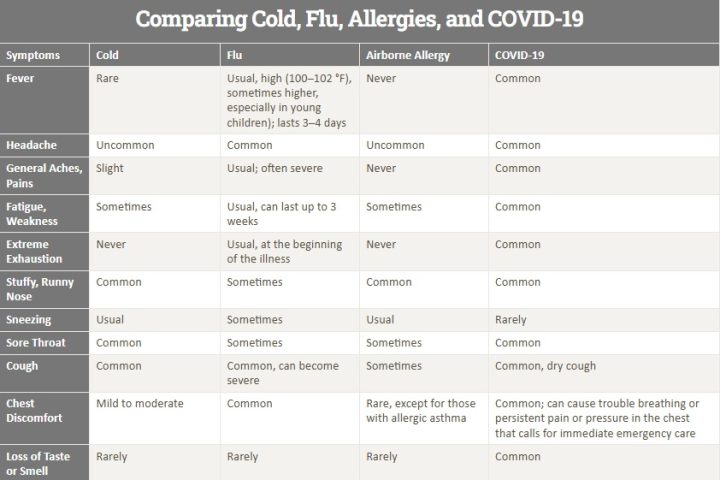
Distinguishing COVID-19 from influenza can be particularly difficult because the symptoms overlap so much. It’s important to not shrug off early warning signs you might be coming down with a sickness, even if it seems like a common cold or allergies. Symptoms of a cold tend to be milder, like a runny nose, cough, congestion and sore throat, while fever, extreme exhaustion and general aches and pains are much more common with COVID-19 and flu.

That said, the taxonomy of these three diseases can be tough to navigate. A chart like this from the National Institutes of Health could be beneficial in your presentation:

Compare Cold, Flu, Allergies and COVID

Recognizing the signs of cold, flu and COVID is only half the battle. Your digital display presentation should also provide tips to prevent these illnesses from spreading and outline healthy habits workers should be working on. Here are a few general best practices to help get your presentation started:

1.       Stay home if you’re unwell

Most workplaces should respect the fact that you’re not coming in to spread germs to other workers when you’re sick. It will cost the company more money to have multiple people miss their shifts than if the original person who showed symptoms just stayed home in the first place. Communicate your company policy and stance on staying home sick. A lot of workers are afraid to call in sick to work, so it’s important to be unambiguous about your expectations. If your policy is for unwell employees to protect their coworkers by staying home and getting better, let them know in your digital display presentation.

2.       Wear a face mask

The first habit your collective workplace should work on is mask-wearing. Even though masks are no longer mandated for COVID, if you have any symptoms that could spread through your workplace, you should be wearing a mask in all spaces where you would come into contact with other individuals.  Create a slide that encourages people to start wearing masks. Masking is proven to be effective at tamping down the spread of all three seasonal vectors, not just COVID. In fact, preventative measures like masking during the pandemic were so effective against other illnesses that an entire strain of influenza went extinct. So encourage workers to wear masks even if they’re not feeling any symptoms, as it can protect them from others, prevent asymptomatic spread and play a part in keeping everyone healthy.

3.       Wash hands frequently

Cold, flu and COVID season requires more frequent hand-washing to remove germs from hands. Your digital display presentation could provide hand-washing tips such as the following: 

  • Wash your hands frequently. 
  • Wet hands and lather with soap—rub for at least 20 seconds. 
  • Scrub all surfaces of the hand, including between your fingers and under your fingernails, wrists and the backs of your hands. 
  • When washing your hands is not an option, use an alcohol-based hand sanitizer that contains at least 60% alcohol.

 You could also include a diagram to illustrate proper hand-washing techniques as an additional way to communicate this in your slides.

4.       Cognizant coughing or sneezing

“Coughs and sneezes spread diseases”—the saying is over a century old and it’s still true today. But coughing, and especially sneezing, in a mask is not always ideal. Your digital display presentation should ensure that people know to properly cough or sneeze into their elbow or a tissue. These are the most effective ways of containing pathogens when experiencing the louder of our involuntary symptoms. Remind folks that used tissues need to be disposed of immediately and that hand-washing or applying sanitizer right after will ensure the germs produced will not be transferred to other surfaces.

5.       Watch what you’re touching

Speaking of germs moving from hands to other objects, another important thing to remember during cold, flu and COVID season is to pay attention to what you’re touching. Most surfaces are crawling with germs. This includes door handles, light switches and many other things we touch daily without thinking. One common way infections are spread is when someone touches something and then touches their eyes, nose or mouth right after. Your digital display presentation should serve as a reminder about how germs are spread, then reiterate the importance of washing your hands after you touch any shared object or surface.

6.       Disinfect surfaces frequently

Communicate that workers should clean and disinfect commonly used surfaces frequently, especially if someone is presenting cold symptoms. Multiple people often touch desks, countertops, computer keyboards and telephones, leaving their germs behind for someone else to pick up. Building a habit of regularly cleaning surfaces helps keep the odds of staying healthy in everyone’s favor.

7.       Keep your distance

When you work in a facility with other people, it can be hard to avoid them. In order to prevent the spread of influenza and COVID-19, it is recommended that people physically distance themselves. During the pandemic, this was called social distancing. Your digital display presentation should recommend that when possible, people should avoid close contact and try to keep six feet between themselves and others.

8.       Vaccination

As part of some companies’ wellness programs, flu and COVID vaccination clinics are offered. If clinics are offered in your workplace, ensure that the dates and times are communicated in your digital display presentation. Or if time off is offered for people to attend vaccination clinics, ensure that this is communicated. Maintaining a healthy work environment during periods of high transmission sickness is a team effort—making certain every worker knows how to play their part individually is the best way to keep them all healthy.

The most important thing about this digital display presentation is to get people talking. Most of the information that will be shared is not new, but a reminder can put things on people’s radars and prevent them from slipping into complicity, especially in a busy month like November. Use our guide to creating digital safety presentations for more ideas to put together a great set of information that engages people in your facility and keeps safety front of mind. Stay healthy (and keep others healthy around you) this holiday season!

On-demand webinar

Using a Human Factors Framework for Safety and Operational Excellence

It can be hard to see the connection between safety, productivity, human factors and organizational systems. This webinar will demonstrate how a human factors framework can impact all areas of an organization, linking individual worker safety and organizational systems and provide an outline that allows leadership to manage safety-focused change.

Watch now

Tagged , , , , , , , , , ,

Construction worker on ladder

OSHA’s top 10 most frequently cited workplace safety standards for fiscal year 2024 were recently announced at the NSC Safety Congress & Expo in Orlando.

If you’ve been paying attention to the rankings over the years, you’ll no doubt have felt an intense sensation of déjà vu with this latest announcement. Not only are the same 10 violations cited year after year but for the previous 14 consecutive years, Fall Protection – General Requirements (1926.501) has been in the number one spot.

This standard outlines the fall protection system requirements to protect employees on walking or working surfaces with an unprotected side or edge six feet off the ground or higher. The citations are for failing to protect workers from avoidable falls due to a lack of training and fall arrest systems, improper fall protection equipment, and ineffective equipment. 

The duty to meet fall protection standards has not changed, and people are very aware of the risks associated with fall protection. So why does it continue to be the most frequently cited violation on job sites?

Our guide Raising the Bar: A Safety Guide to Working at Heights sums it up best:

“There are several factors conspiring against workers once their feet leave the ground.

Complacency and the normalization of risk lulls experienced workers into a false sense of comfort—and leads them to take riskier actions.

Compounding risk makes a bad situation worse—and often workers don’t even realize it.  

Human error can strike anyone at any time—especially as people rush or become tired.

Supervisory effectiveness can dramatically sway the risk of working at heights—either positively or negatively.”

People generally do not want to be cited for violating this standard—for both financial reasons and to avoid having the poor reputation that comes with non-compliance. But it would be even worse if a tragedy occurred as a result of this violation. Let’s not forget that a failure to comply with the Fall Protection – General Requirements standard makes the mental and physical states we experience like exhaustion and rushing much more dangerous. All too often, human factors are the underlying cause of accidents and incidents, and unless you’re asking the question of why something happened, you may not find the cause.

The plan, provide and train approach to fall prevention is the best way to prepare for all incident causes, including human factors:

  • PLAN ahead to get the job done safely. Working at heights is not just an up-and-down job. In order to ensure safety, every risk must be considered, including human factors.
  • PROVIDE the right equipment. A big part of why people are being cited is that workers do not have the right ladders, scaffolding or safety gear for the job they’re performing. The right equipment for the job should be determined in the planning stage when the risk assessment is done.
  • TRAIN everyone to use the equipment safely. But also train the workers to understand how to navigate all of the hazards on the job, including those impacted by human factors. 

Based on old lists of OSHA’s most-cited standards (like these from 2015 and 2017), it’s a sure bet that organizations will continue to be written up for failing to meet the Fall Protection – General Requirements standard. For decades, workers have been aware of this problem but their desire to get things done in as little time as possible, combined with other human factors like complacency, fatigue and frustration, can make them vulnerable to making critical errors that increase their risk of falling. 

Safety pros need to intervene if change is going to happen, and they may as well start at the top of OSHA’s list. Gravity and human factors are a hazardous combination, and if they aren’t addressed workers run the risk of injury or death. Why not try to get ahead of the problem and help break Fall Protection’s top citation streak? Raising the Bar: A Safety Guide to Working at Heights is an excellent place to start to get the conversation flowing when it comes to keeping workers safe after they leave the ground.

Guide to Falls from Heights

Safer Workers at Heights

Falls from heights is a stubborn problem—but not for the reasons you think. Here’s how to protect people working at heights.

Get the free guide now

Tagged , , , , , , ,